Category: Jetty

  • End of Life: Changes to Eclipse Jetty and CometD

    Webtide (https://webtide.com) is the company behind the open-source Jetty and CometD projects. Since 2006, Webtide has fully funded the Jetty and CometD projects through services and support, including migration assistance, production support, developer assistance, and CVE resolution. 

    First, the change.

    Starting January 1, 2026, Webtide will no longer publish releases for Jetty 9, Jetty 10, and Jetty 11, as well as CometD 5, 6, and 7 to Maven Central or other public repositories. 

    Take a look at the primary announcement if you’re interested. 

    So, the motivation.

    Why we are in this situation now harks back to the beginnings of Webtide. Briefly, Greg Wilkins founded the Jetty project in 1995 as part of a contest created by Sun Microsystems for a new language called Java. For a decade, he and Jan Bartel carefully stewarded the project as part of their consulting company Mort Bay Consulting. Around the Jetty 6 timeframe, in 2006, Webtide was founded as an LLC to evolve the project further commercially. Still, at its core, the goal was to support the incredible community that had developed over the years. When I joined in 2007, we began working to join the Eclipse Foundation. We took steps to formalize our development processes, aiming to add more commercial predictability to the open-source project. Joining the Eclipse Foundation also meant adhering to their rigorous IP policy for both the Jetty codebase and its dependencies, an essential step in improving corporate uptake.

    This was also the time for the project to handle the end-of-life process for Jetty 6, while establishing Jetty 7 and Jetty 8. This was the opportunity that Webtide needed to support the project’s development by offering commercial services and support for EOL Jetty 6, while focusing on supporting and funding the future of Jetty 7 and Jetty 8. 

    It was the crux; after careful consideration, we decided that all commercial support releases would be open-source for the benefit of all. While not a traditional business decision, it aligned with our values and dedication to the community, which was rewarded as the community continued to grow its usage of Jetty.

    This worked wonderfully for almost 20 years.

    Something shifted…

    We started to notice a shift in the community a few years ago. For almost 20 years, the companies we spoke with valued how our support could help them become more successful, with many ultimately becoming customers who truly understood the benefits of supporting open-source. Every single one of them saw the value in releasing EOL releases freely. When I became CEO a decade ago and Webtide became 100% developer-owned and operated, we were able to continue operating in this commercial environment with ease, to such an extent that the future of Webtide and the Jetty project is assured for many years to come.

    So what changed? The tone of many companies we spoke to. Increasingly, while explaining the model that served Webtide well for so many years, where I used to hear ‘That makes so much sense, this works great!’, I now hear “So it’s just free? Great, I need to check a box.” Followed up with the galling question “Could you put this policy of yours in writing on your company letterhead?”.

    And today?

    Twenty years ago, things were different; Maven 2 dominance was emerging, and Maven Central was gaining ubiquity. Managing transitive dependencies was novel in many circles. Managing CVEs in a corporate setting was in its infancy, particularly with Java developer software stacks. 

    Now, build tooling is diverse, Maven Central is a global central repository system, and corporations should have their own caching repository servers, or they really should! Even JavaEE was rebranded as Jakarta at the Eclipse Foundation. So much change, but the one I’ll highlight is the emergence of business units focused on corporate software policies, complete with BOM files containing ever more metadata and checkboxes to click, managing CVE risks associated with software developed internally. Developers, the primary people Webtide has interacted with over the years, are increasingly far removed from software maintenance activities. 

    Now our approach to endlessly updating EOL releases seems remarkably outdated. Look at Jetty 9, which we have been releasing since 2013. It turns out our approach of making things as easy as possible for the community, for software that should have officially gone EOL years ago, was a benefit to many, but also enabled far more to grow complacent. Instead of scheduling migrations and updating to more recent versions, we inadvertently provided an environment that allowed companies to deploy onto software well over a decade old, when newer, more performant options were readily available. Then, when security postures started changing and businesses began looking deeper into their dependencies, they realized they were using outdated software, three or more major versions behind. Then, to our shock, many are perfectly fine with that so long as it is free and someone tells them it is ok. 

    If we have learned one thing within this time, it is that the EOL policy needs to be so much clearer, using established industry terminology. Looking back, we have been guilty of inventing terminology and inadvertently exacerbating the situation.

    What is heartening is seeing other organizations work to address EOL as well; notably, MITRE has been developing changes to the CVE system to support EOL concepts fully. If you have ever seen the text “Unsupported When Assigned” in a CVE, then you have encountered the early efforts for EOL in a CVE.

    You have to applaud the efforts of businesses to prioritize security and sane open-source policies.

    However, this is also a call to open-source projects like Jetty, as we are operating in a different world. Everyone understands that ‘End-of-Life’ does not mean ‘End-of-Use’. Clearly, the system for many companies has changed from a Developer Support perspective to a Security Support perspective. EOL Software support is purchased differently now. There are companies, like Sonar (formerly Tidelift), that exist to manage security metadata about open-source software, enabling companies to manage their software risk more effectively. 

    EOL Jetty and CometD by Webtide

    To address this industry evolution, Webtide has launched a partnership program that enables businesses relying on EOL Jetty and CometD versions to obtain CVE resolutions officially and predictably. 

    Webtide continues to resolve CVEs and issues for EOL Jetty and CometD in support of our commercial customers. However, the resulting binaries are now distributed directly to our commercial support customers and through our partnership network. No longer are we calling software EOL but deploying to Maven Central with a nod and a wink.

    Our partners are established leaders in the open-source EOL landscape, creating products that directly address the problems the security and business industries are facing. 

    This synergy works perfectly with Webtide, as we are the company that offers services and support on Jetty and CometD. Migrations, developer assistance, production support, and performance are the things that directly influence the ongoing development of the open-source projects we steward. We can continue to focus on our strengths, and our partners can focus on theirs.

    At last, the partners!

    We are pleased to announce two partnerships. With these partners, you will be able to build a secure EOL solution for your software stack, not just for your usage of Jetty or CometD. Best yet, if you are interested in Webtide’s Lifecycle Support, you can use these partner versions in conjunction with our support!


    TuxCare secures the open-source software the world builds on. Today, we protect over 1.2 million workloads – keeping them secure, compliant, and unstoppable at scale. From operating systems to development libraries and production applications, we power your open-source stack with enterprise-grade security and support, including endless lifecycle extensions for out-of-support software versions, rebootless patching for every major Linux distribution, enterprise-optimized support for community Linux, and our Linux-first vulnerability scanner that cuts through the noise.


    HeroDevs provides secure, long-term maintenance for open-source frameworks that have reached End-of-Life. Through our Never-Ending Support (NES) initiative, we deliver continuous CVE remediation and compliance-grade updates, allowing your team to migrate at your own pace. Our engineers monitor upstream changes, backport verified fixes, and publish fully tested binaries for seamless drop-in replacement. With NES for Jetty and NES for CometD, you can stay secure, stable, and compliant—without refactoring or rushing a migration.

    If your business is interested in our partner program, please direct inquiries to partnership@webtide.com.

    Wrapping it up.

    One important thing to note is that Webtide will continue to support the Jetty Project with a standard open-source release process, ensuring that older versions are released to provide the community with ample time to update to newer versions through a transition period. When Jetty 13 is released, Jetty 12.1 will continue to receive updates for a period, just as Jetty 12.0 does currently. If that is six months or a year, it remains to be seen. Once we finalize this release strategy with timelines, we will make sure the community is well-informed.

    Fundamentally, the change coming is that the End of Life versions for Jetty and CometD will no longer be an empty EOL notice and quiet deployments to Maven Central. It will mean EOL and provide established industry solutions to address those who need additional support.
  • Google App Engine Performance Improvements

    Over the past few years, Webtide has been working closely with Google to improve the usage of Jetty in the App Engine Java Standard Runtime. We have updated the GAE Java21 Runtime to use Jetty 12 with support for both EE8 and EE10 environments. In addition, a new HttpConnector mode has been added to increase the performance of all Java Runtimes, this is expected to result in significant cost savings from less memory and CPU usage.

    Bypassing RPC Layer with HttpConnector Mode

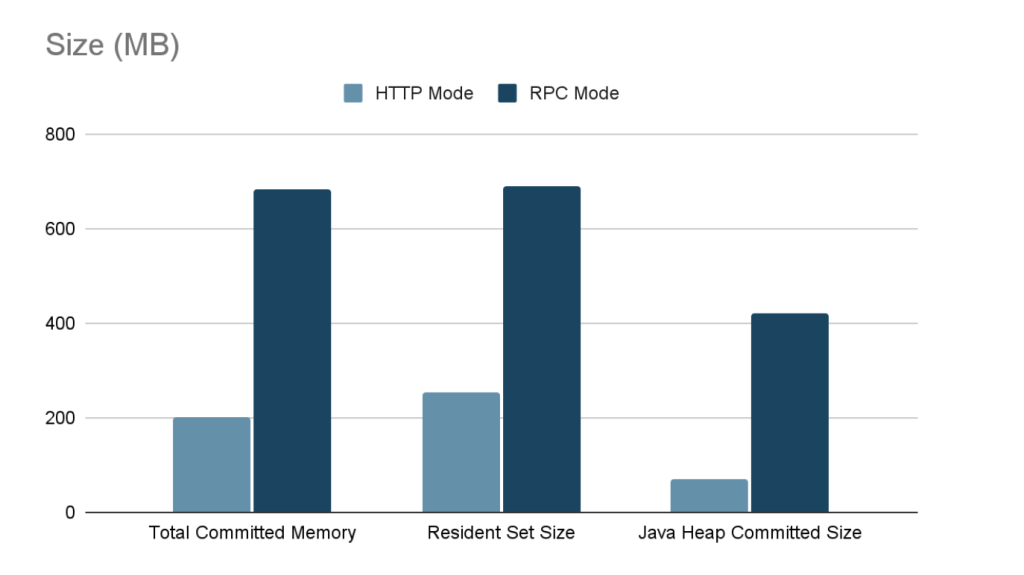
    Recently, we implemented a new mode for the Java Runtimes which bypasses the legacy gRPC layer which was previously needed to support the GEN1 runtimes. This legacy code path allowed support of the GEN1 and GEN2 Runtimes simultaneously, but had significant overhead; it used two separate Jetty Servers, one for parsing HTTP requests and converting to RPC, and another using a custom Jetty Connector to allow RPC requests to be processed by Jetty. It also required the full request and response content to be buffered which further increased memory usage.

    The new HttpConnector mode completely bypasses this RPC layer, thereby avoiding the overhead of buffering full request and response contents. Additionally, it removes the necessity of starting a separate Jetty Server, further reducing overheads and streamlining the request-handling process.

    Benchmarks

    Benchmarks conducted on the new HttpConnector mode have demonstrated significant performance improvements. Detailed results and documentation of these benchmarks can be found here.

    Usage

    To take advantage of the new HttpConnector mode, developers can set the appengine.use.HttpConnector system property in their appengine-web.xml file.

    <system-properties>
        <property name="appengine.use.httpconnector" value="true"/>
    </system-properties>

    By adopting this configuration, developers can leverage the enhanced performance and efficiency offered by the new HttpConnector mode. This is available for all Java Runtimes from Java8 to Java21.

    This mode is currently an optional configuration but future plans are to make this the default for all applications.

  • If Virtual Threads are the solution, what is the problem?

    Java’s Virtual Threads (aka Project Loom or JEP 444) have arrived as a full platform feature in Java 21, which has generated considerable interest and many projects (including Eclipse Jetty) are adding support.

    I have previously been somewhat skeptical about how significant any advantages Virtual Threads actually have over Platform Threads (aka Native Threads). I’ve also pointed out that cheap Threads can do expensive things, so that using Virtual Threads may not be a universal panacea for concurrent programming.

    However, even with those doubts, it is clear that Virtual Threads do have advantages in memory utilization and speed of startup. In this blog we look at what kinds of applications may benefit from those advantages.

    In short we investigate what scalability problems are Virtual Threads the solution for.

    Axioms

    Firstly let’s agree on what is accepted about Virtual Thread usage:

    • Writing asynchronous code is extraordinary difficult. “Yeah I know” you say… yeah but no, it is harder than that! Avoiding the need to write application logic in asynchronous style is key to improving the quality and stability of an application. This blog is not generally advocating you write your applications in an asynchronous style.
    • Virtual Threads are very cheap to create. From a performance perspective there is no reason to pool already started Virtual Threads and such pools are considered an anti pattern. If a Virtual Thread is needed, then just create a new one.
    • Virtual Threads use less memory. This is accepted, but with some significant caveats. Specifically the memory saving is achieved because Virtual Threads only allocate stack memory as needed, whilst Platform Threads provision stack size based on a worst case maximal usage. This is not exactly an apples vs oranges comparison.

    If some are good, are more even better?

    Consider a blocking style application is running on a traditional application server that is not scaling sufficiently. On inspection you see that all the Threads in the pool (default size 200) are allocated and that there are no Threads available to do more work!

    Would making more Threads available be the solution to this scalability problem? Perhaps 2000 Platform Threads will help? Still slow? Let’s try 10,000 Platform Threads! Running out of memory? Then perhaps unlimited Virtual Threads will solve the scalability problems?

    What if on further inspection it is found that the pool Threads are mostly blocked waiting for a JDBC Database connection from the JDBC Connection Pool (default size 8) and that as a result the Thread pool is exhausted.

    If every request needs the database, then any additional Threads will all just block on the same JDBC pool, thus more Threads will not make a more Scalable solution.

    Alternatively, if only some requests need to use the database, then having more Threads would allow request that do not need the database to proceed to completion. However, a fraction of requests would still end up blocked on the JBDC pool. Thus any limited Platform Thread pool could still become exhausted.

    With unlimited Virtual Threads there is no effective limit on the number of Threads, so non database requests could always continue, but the queue of Threads waiting on JBDC would also be unlimited as would the total of any resources held by those Threads whilst waiting. Thus the application would only scale for some types of request, whilst giving JDBC dependent requests the same poor Quality of Service as before.

    Finite Resources

    If an application’s scalability is constrained by access to a finite resource, then it is unlikely that “more Threads” is the solution to any scalability problems. Just like you can’t solve traffic by adding cars to a congested road, adding Threads to an already busy server may make things worse.

    Some common examples of finite resources that applications can encounter are:

    • CPU: If the server CPU is near 100% utilization, then the existing number of Threads are sufficient to keep it fully loaded. More and/or faster CPUs are needed before any increase in Threads could be beneficial.
    • Database: Many database technologies cannot handle many concurrent requests, so parallelism is restricted. If the bottleneck is the database, then it needs to be re-engineered rather than laid siege to by more concurrent Threads.
    • Local Network: An application may block reading or writing data because it has reached the limit on the local network. In such cases, more Threads will not increase throughput, but they might improve latency if some threads can progress reading new requests and have responses ready to write once network becomes less congested. However there is a cost in waiting (see below).
    • Locks: Parallel applications often use some form of lock or mutual exclusion to serialize access to common data structures. Contention on those locks can limit parallelism and require redesign rather than just more Threads.
    • Caches: CPU, memory, file system and object caches are key tools in speeding up execution. However, if too many different tasks are executed concurrently, the capacity of these caches to hold relevant data may be exceeded and execution with a cold cache can be very slow. Sometimes it is better to do less things concurrently and serialize the excess so that caches can be more effective that trying to do everything at once.

    If an application’s lack of scalability is due to Threads waiting for finite resources, then any additional Threads (Platform or Virtual) are unlikely to help and may make your application less stable. At best, careful redesign is needed before Thread counts can be increased in any advantageous way.

    Infinite (OK Scalable) Resources

    Not all resources are finite and some can be considered infinite, at least for some purposes. But let’s call them “Scalable” rather than infinite. Examples of scalable resources that an application may block on include:

    • Database: Not all databases are created equal and some types of database have scalability in excess of the request rates experienced by a server. However, such scalability often comes at a latency cost as the database may be remote and/or distributed, thus applications may block waiting for the database, even if it has capacity to handle more requests in parallel.
    • Micro services: A scalable database is really just a specific example of a micro service that may be provided by a remote and/or distributed system that has effectively infinite capacity at the cost of some latency. Applications can often find themselves waiting on one or more such services.
    • Remote Networks: Local data center networks are often very VERY fast and in many situations they can outstrip even the combined capacity of many client systems. An application sending/receiving larger content may may block writing/reading them due to a slow client, but still have enough local network capacity to communicate with many other clients in parallel.
    • Local Filesystems: Typically file systems are faster than networks, but slower than CPU. They also may have significant latency vs throughput tradeoffs (less so now that drives seldom need to spin physical disks). Thus Threads may block on local IO even though there is additional capacity available.

    Applications that lack scalability due to Threads waiting for such scalable resources may benefit from more Threads. Whilst some Threads are waiting for the a database, micro service, slow client network or file system, it is likely that other Threads can progress even if they need to access the same types of resources.

    Platform Threads pools can easily be increased to many 1000’s or more before typical servers will have memory issues. If scalability is needed beyond that, then Virtual Threads can offer practically unlimited additional Thread, but see the caveats below.

    Furthermore, the fast starting Virtual Threads can be of significant benefit in situations where small jobs with long latency can be carried out in parallel. Consider an application that processes request using data from several micro services, each with some access latency. If these are done serially, then the total request latency is the summation of all. Sometimes asynchronous code is used to execute micro service request in parallel, but spinning up a couple of Virtual Threads in this situation is simpler, less error prone and applicable to more APIs.

    Too Much of a Good Thing?

    There is also some concern with low latency scalable resources that seldom block with Virtual Threads. Since Virtual Threads are not preempted, there can be starvation and/or fairness problems if they are not blocked by slow resources. This is probably a good problem to have, but will need some management on extreme scales for some applications.

    The Cost of Waiting

    We have identified that there are indeed scalable resources on which an application may wait with many Threads. However, there is no such thing as a free lunch and waiting Threads may have a significant cost, even if they are Virtual. Specifically how/where an application waits can greatly affect resource usage.

    Consider a traditional application server with a limited Thread pool that is running near capacity, but with additional demand. While the 200 odd Threads are busy handling 200 concurrent request, there are additional request waiting to be handled. However, in an asynchronous server like Jetty, those additional requests can be cheaply parked and may be represented just be a single set bit in a selector or perhaps a tiny entry in a queue that holds only a reference to a connection that is ready to be read.

    Now consider if requests were serviced by Virtual Threads instead of waiting for a pooled Platform Thread to become available. Pending requests would be allowed to proceed to some blocking point in the application. Waiting like this within the application can have additional expenses including:

    • An input buffer will be allocated to read the request and any content it has.
    • A read is performed into the input buffer, thus removing network back pressure so a client is enabled to send more request/data even if the server is unable to handle them.
    • An object representation of the request will be built, containing at least the meta data and frequently some application data if there is an XML or JSON payload
    • Sessions may be activated and brought into memory from caches or passivation stores.
    • The allocated Thread runs deep inside the application code, potentially reaching near maximal stack depth.
    • Application objects created on the heap are held in memory with references from the stack.
    • An output buffer may be allocated, along with additional character conversion resources.

    When request handling blocks within the application, all these additional resources may be allocated and held during that wait. Worse still, because of the lack of back pressure, a client may send more request/data resulting in more Threads and associated resources being allocated and also being held whilst the application waits for some resource.

    Provisioning for the Worst Case

    We have seen that there are indeed applications that may benefit from having additional Threads available to service requests. But we have also seen that such additional Threads may incur additional costs beyond just the stack size. Waiting/Blocking within an application will typically be done with a deep stack and other resources allocated. Whilst Virtual Threads might be effectively infinite, it is unlikely that these other required resources are equally scalable.

    When an application experiences a worst case peak in load, then ultimately some resource will run out. To provide good Quality of Service, it is vital that such resource exhaustion is handled gracefully, allowing some request handling to continue rather than suffering catastrophic failure.

    With traditional Platform Thread based pools, stack memory is already provisioned for worst case stacks for all Threads and the thread pool sized limit is also an indirect limit on the number of concurrent resources used. Threads have sufficient resources available to complete there handling whilst any excess requests suffer latency whilst waiting cheaply for an available Thread. Furthermore, the back pressure resulting from not reading all offered requests can prevent additional load from sent by the clients. Thread limits are imperfect resource limits, but at least they are some kind of limit that can provide some graceful degradation under load.

    Alternatively, an application using Virtual Threads that has no explicit resource management will be likely to exhaust some of the resources used by those Threads. This can result in an OutOfMemoryException or similar, as the unlimited Virtual Threads each allocate deep stacks and other resources needed for request handling. The cost of average memory savings may be insufficient provisioning for the worst case resulting in catastrophic failure rather than graceful degradation. An analogy is that building more roads can actually make traffic worse if the added cars overwhelm other infrastructure.

    Many applications are written without explicit resource limitations/management. Instead they rely on the imperfect Thread pool for at least some minimal protection. If that is removed, then some form of explicit resource limitation/management is likely to be needed in its place. Stable servers need to be provisioned for the worst case, not the average one.

    Conclusion

    There are applications that can scale better if more Threads are available, but it is not all applications (at least not without significant redesign). Consideration needs to be given to what will limit the worst case load for a server/application if it is not to be Threads. Specifically, the costs of waiting within the application may be such that scalability is likely to have a limit that will not be enforced by practically infinite Virtual Threads.

    It may be that resources have limitations well within the capacity of large but limited Platform Thread pools, which are perfectly capable of scaling to many thousands of threads. So experiments with scaling a Platform Thread pool should first be used to see what limits do apply to an application.

    If no upper limit is found before Platform Threads exhaust kernel memory, then Virtual Threads will allow scaling beyond that limit until some other limit is found. Thus the ultimate resource limit will need to be explicitly managed if catastrophic failure is to be avoided (but, to be fair, applications using Thread pools should also do some explicit resource limit management rather than rely just on the course limits of a Thread pool).

    Recommendation

    If Virtual Threads are not the general solution to scalability then what is? There is no one-size-fits-all solution, but I believe many applications that are limited by blocking on the network would benefit from being deployed in a server like Eclipse Jetty, that can do much of the handling for them asynchronously. Let Jetty read your requests asynchronously and prepare the content as parsed JSON, XML, or form data. Only then allocate a Thread (Virtual or Platform) with a large output buffer so the application can be written in blocking style, but will not block on either reading the request or writing the response. Finally, once the response is prepared, then let Jetty flush it to the network asynchronously. Jetty has always somewhat supported this model (e.g. by delaying dispatch to a Servlet until the first packet of data arrives), but with Jetty-12 we are adding more mechanisms to asynchronously prepare requests and flush responses, whilst leaving the application written in blocking style. More to come on this in future blogs!

  • Security Audit with Trail of Bits

    Several months ago, the Eclipse Foundation approached the Eclipse Jetty project with the offer of a security audit. The effort was being supported through a collaboration with the Open Source Technology Improvement Fund (OSTIF), with the actual funding coming from the Alpha-Omega Project.

    Upon reflection, this collaboration could not have come at a better time for the Jetty open-source project. Completing this security audit before the first release of Jetty 12 was serendipitous. While the collaboration results with Trail of Bits are just now being published, the work has primarily been completed for a couple of months. 

    When we started this audit effort, Jetty 12 was quickly shaping up to be one of the most exciting releases we have ever worked on in the history of Jetty. Support for protocols like HTTP/3 further refined the internals of Jetty to be a modern, scalable network component. Coupling that with a refactoring of the internals to remove strict dependency on Servlet Request and Response objects, the core of Jetty became a more general server component with scalable and performant applications being able to be developed directly in Jetty without the strict requirement for Servlets. This ultimately allowed us to add a new Environment concept that supports multiple versions of the Servlet API on the same Jetty server simultaneously; mixing javax.servlet and jakarta.servlet on the same server allows for many exciting options for our users.

    However, these changes and exciting new features mean that quite a bit has changed, and when many moving parts are evolving, there is always a risk of unwanted behaviors.

    Our committers had low expectations of what this engagement would lead to, as our previous experience with various code analysis tooling often resulted in too many false positives.  Part of the prep work to start this review required us to draw an appropriate-sized box around the Jetty project code where we felt a review was most warranted. It should come as no surprise that much of this code is some of the more nuanced and complex with Jetty. So, throwing caution to the wind, we prepared and submitted the paperwork.

    We could not have been more pleased with how the engagement proceeded from here. Trail of Bits was chosen as the company to perform the review, and it met and exceeded our expectations by far. Sitting down with their engineers, it was apparent they were excited to be working on an open-source project of Jetty’s maturity, and when their work was completed, they demonstrated a much more complete understanding of the reviewed code than the Jetty team expected.

    Ultimately, we could not have been happier with how this effort was executed. The Eclipse Jetty project members are very thankful to the Eclipse Foundation, OSTIF, and Trail of Bits for making this collaboration a resounding success!

    Other References

  • New Jetty 12 Maven Coordinates

    Now that Jetty 12.0.1 is released to Maven Central, we’ve started to get a few questions about where some artifacts are, or when we intend to release them (as folks cannot find them).

    Things have change with Jetty, starting with the 12.0.0 release.

    First, is that our historical versioning of <servlet_support>.<major>.<minor> is no longer being used.

    With Jetty 12, we are now using a more traditional <major>.<minor>.<patch> versioning scheme for the first time.

    Also new in Jetty 12 is that the Servlet layer has been separated away from the Jetty Core layer.

    The Servlet layer has been moved to the new Environments concept introduced with Jetty 12.

    EnvironmentJakarta EEServletJakarta NamespaceJetty GroupID
    ee8EE84javax.servletorg.eclipse.jetty.ee8
    ee9EE95jakarta.servletorg.eclipse.jetty.ee9
    ee10EE106jakarta.servletorg.eclipse.jetty.ee10
    Jetty Environments

    This means the old Servlet specific artifacts have been moved to environment specific locations both in terms of Java namespace and also their Maven Coordinates.

    Example:

    Jetty 11 – Using Servlet 5
    Maven Coord: org.eclipse.jetty:jetty-servlet
    Java Class: org.eclipse.jetty.servlet.ServletContextHandler

    Jetty 12 – Using Servlet 6
    Maven Coord: org.eclipse.jetty.ee10:jetty-ee10-servlet
    Java Class: org.eclipse.jetty.ee10.servlet.ServletContextHandler

    We have a migration document which lists all of the migrated locations from Jetty 11 to Jetty 12.

    This new versioning and environment features built into Jetty means that new major versions of Jetty are not as common as they have been in the past.


  • Jetty 12 – Virtual Threads Support

    Executive Summary

    Virtual Threads, introduced in Java 19, are supported in Jetty 12, as they have been in Jetty 10 and Jetty 11 since 10.0.12 and 11.0.12, respectively.

    When virtual threads are supported by the JVM and enabled in Jetty (see embedded usage and standalone usage), applications are invoked using a virtual thread, which allows them to use simple blocking APIs, but with the scalability benefits of virtual threads.

    Introduction

    Virtual threads were introduced as a preview feature in Java 19 via JEP 425 and in Java 20 via JEP 436, and finally integrated as an official feature in Java 21 via JEP 444.

    Historically, the APIs provided to application developers, especially web application developers, were blocking APIs based on InputStream and OutputStream, or based on JDBC.
    These APIs are very simple to use, so applications are simple to develop, understand and troubleshoot.

    However, these APIs come with a cost: when a thread blocks, typically waiting for I/O or a contended lock, all the resources associated with that thread are retained, waiting for the thread to unblock and continue processing: the native thread and its native memory are retained, as well as network buffers, lock structures, etc.

    This means that blocking APIs are less scalable because they retain the resources they use.
    For example, if you have configured your server thread pool with 256 threads, and all are blocked, your server cannot process other requests until one of the blocked threads unblocks, limiting the server’s scalability.

    Furthermore, if you increase the server thread pool capacity, you will use more memory and likely require bigger hardware.

    Asynchronous/Reactive

    For these reasons, non-blocking asynchronous and reactive APIs have been introduced. The primary examples are the asynchronous I/O APIs introduced in Servlet 3.1 and reactive APIs provided by libraries such as RxJava and Spring’s Project Reactor, based on Reactive Streams.
    Unfortunately, REST APIs such as JAX-RS or Jakarta RESTful Web Services have not been (fully) updated with non-blocking APIs, so web applications that use REST are stuck with blocking APIs and scalability problems.

    Essential to note is that asynchronous and reactive APIs are more difficult to use, understand, and troubleshoot than blocking APIs, but are more scalable and typically achieve similar performances at a fraction of the resources. We have seen web applications that, when switched from blocking APIs to non-blocking APIs, reduced the threads usage from 1000+ to 10+.

    Virtual threads aim to be the best of both worlds: simple-to-use blocking APIs for developers, with the scalability of non-blocking APIs provided by the JVM.

    Jetty 12 Architecture

    The Jetty 12 architecture, at its core, is completely non-blocking and uses an AdaptiveExecutionStrategy (formerly known as “eat what you kill” which was covered in previous blogs here and here) to determine how to consume tasks.

    The key feature of AdaptiveExecutionStrategy is that it has a strong preference for consuming tasks in the same thread that produces them, so they are executed with a hot CPU cache, without parallel slowdown and no context-switch latency, yet avoids the risk of the server exhausting its thread pool.

    Simplifying a bit, each task is marked either as blocking or non-blocking; AdaptiveExecutionStrategy looks at the task and at how many threads are available to decide how to consume the task.

    If the task is non-blocking, the current thread runs it immediately.
    Otherwise, if no other threads are available to continue producing tasks, the current thread takes over the production of tasks and gives the tasks to an Executor, where they are likely queued and executed later by different threads.

    Virtual Threads Integration

    This architecture made it easy to integrate virtual threads in Jetty: when virtual threads are supported by the JVM and Jetty’s virtual threads support is enabled (see embedded usage and standalone usage), AdaptiveExecutionStrategy consumes a blocking task by offering the task to the virtual thread Executor rather than the native thread Executor, so that a newly spawned virtual thread runs the blocking task.

    That’s it.

    As a Servlet Container implementation, Jetty calls Servlets assuming they will use blocking APIs, so the task that invokes the Servlet is a blocking task.
    When virtual threads are supported and enabled, the thread that calls Servlet Filters and eventually the HttpServlet.service(...) method is a virtual thread.

    For non-blocking tasks, it is more efficient to have them run by the same native thread that created them; it is only for blocking tasks that you may want to use virtual threads.

    Conclusions

    Jetty’s AdaptiveExecutionStrategy allows the best of all worlds.
    Jetty provides a fast scalable asynchronous implementation, which avoids any possible limitations of virtual threads, whilst giving applications the full benefits of virtual threads. 

    Jetty deals with complex asynchronous concerns, so you don’t have to!

  • Introducing Jetty-12

    For the last 18 months, Webtide engineers have been working on the most extensive overhaul of the Eclipse Jetty HTTP server and Servlet container since its inception in 1995. The headline for the release of Jetty 12.0.0 could be “Support for the Servlet 6.0 API from Jakarta EE 10“, but the full story is of a root and branch overhaul and modernization of the project to set it up for yet more decades of service.

    This blog is an introduction to the features of Jetty 12, many of which will be the subject of further deep-dive blogs.

    Servlet API independent

    In order to support the Servlet 6.0 API, we took the somewhat counter intuitive approach of making Jetty Servlet API independent.  Specifically we have removed any dependency on the Servlet API from the core Jetty HTTP server and handler architecture.    This is taking Jetty back to it’s roots as it was Servlet API independent for the first decade of the project.

    The Servlet API independent approach has the following benefits:

    • There is now a set of jetty-core modules that provide a high performance and scalable HTTP server.  The jetty-core modules are usable directly when there is no need for the Servlet API and the overhead introduced by it’s features and legacy.
    • For projects like Jetty, support must be maintained for multiple versions of the Servlet APIs.  We are currently supporting branches for Servlet 3.1 in Jetty 9.4.x;  Servlet 4.0 in Jetty 10.0.x; and Servlet 5.0 in Jetty 11.0.x. Adding a fourth branch to maintain would have been intolerable.  With Jetty 12, our ongoing support for Servlet 4.0, 5.0 and 6.0 will be based on the same core HTTP server in the one branch. 
    • The Servlet APIs have many deprecated features that are no longer best practise. With Servlet 6.0, some of these were finally removed from the specification (e.g. Object Wrapper Identity). Removing these features from the Jetty core modules allows for better performance and cleaner implementations of the current APIs.

    Multiple EE Environments

    To support the Servlet APIs (and related Jakarta EE APIs) on top of the jetty-core, Jetty 12 uses an Environment abstraction that introduces another tier of class loading and configuration. Each Environment holds the applicable Jakarta EE APIs needed to provide Servlet support (but not the full suite of EE APIs).

    Multiple environments can be run simultaneously on the same server and Jetty-12 supports:

    • EE8 (Servlet 4.0) in the java.* namespace,
    • EE9 (Servlet 5.0) in the jakarta.* namespace with deprecated features
    • EE10 (Servlet 6.0) in the jakarta.* namespace without deprecated features.
    • Core environments with no Servlet support or overhead.
    The implementation of EE8 & EE9 environments are substantially from the current Jetty-10 and Jetty-11 releases, so that applications that are dependent on those can be deployed on Jetty-12 with minimal risk of changes in behaviour (i.e. they are somewhat “bug for bug compatible”). Even if there is no need to simultaneously run different environments, the upgrading of applications to current and future releases of the Jakarta EE specifications, will be simpler as it is decoupled from a major release of the server itself. For example, it is planned that EE 11 support (probably with Servlet 6.1) will be made available in a Jetty 12.1.0 release rather than in a major upgrade to a 13.0.0 release.

    Core Environment

    As mentioned above, the jetty-core modules are now available for direct support of HTTP without the need for the overhead and legacy of the Servlet API. As part of this effort many API’s have been updated and refined:
    • The core Sessions are now directly usable
    • A core Security model has been developed, that is used to implement the Servlet security model, but avoids some of the bizarre behaviours (I’m talking about you exposed methods!).
    • The Jetty Websocket API has been updated and can be used over the top of the core Websocket APIs
    • The Jetty HttpClient APIs have been updated.

    Performance

    Jetty 12 has achieved significant performance improvements. Our continuous performance tracking indicates that we have equal or better CPU utilisation for given load with lower latency and no long tail of quality of service. 

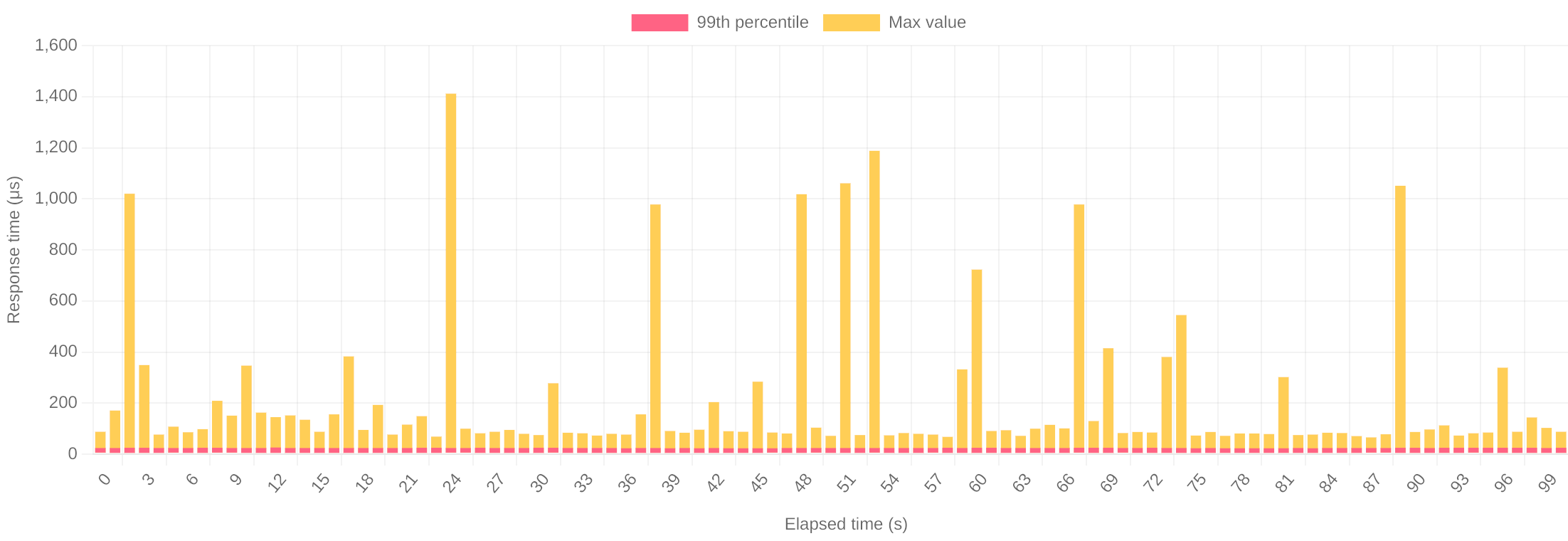
    Our tests currently offer 240,000 requests per second and then measure quality of service by latency (99th percentile and maximum). Below is the plot of latency for Jetty 11: 

    This shows that the orange 99th percentile latency is almost too small in the plot to see (at 24.1 µs average), and all you do see is the yellow plot of the maximal latency (max 1400 µs). Whilst these peaks look large, the scale is in micro seconds, so the longest maximal delay is just over 1.4 milliseconds and 99% of requests are handled in 0.024ms!

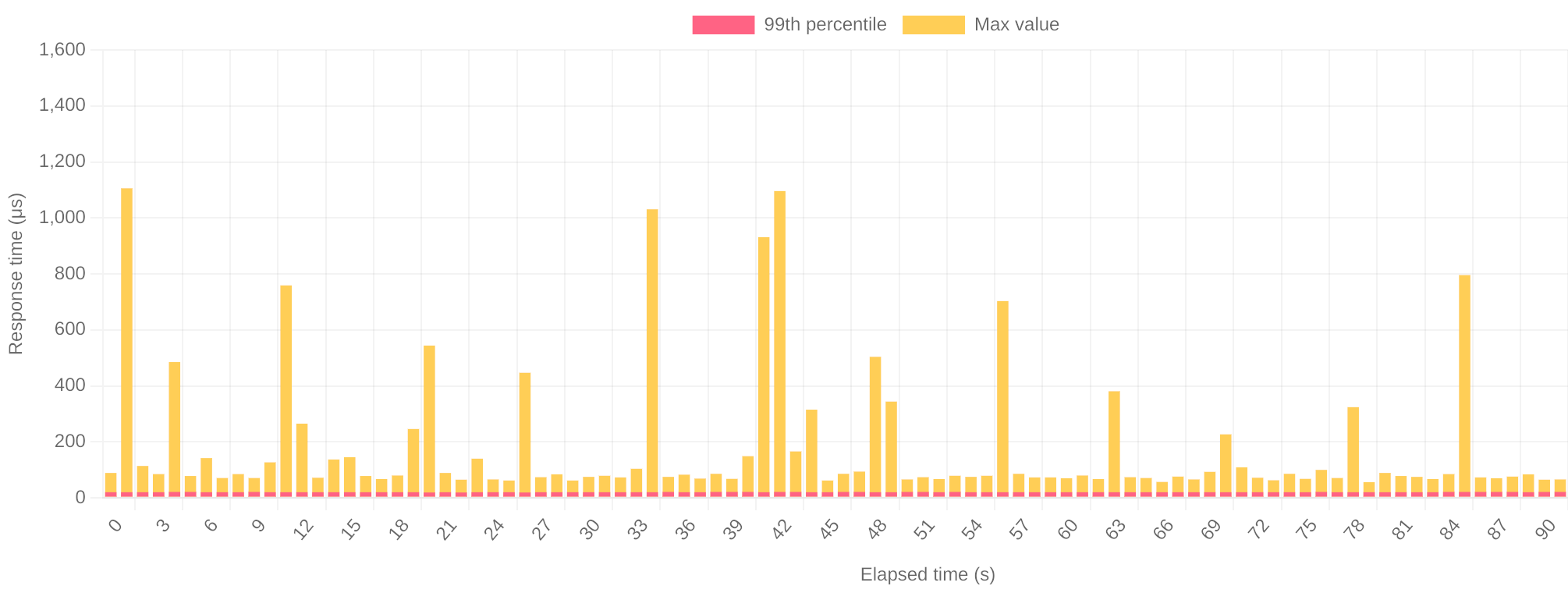
    Below is the same plot of latency for Jetty 12 handling 240,000 requests per second:

    The 99th percentile latency is now only 20.2 µs and the peaks are less frequent and rarely over 1 ms, with the maximum of 1100µs.   

    You can see the latest continuous performance testing of jetty-12 here.

    New Asynchronous IO abstraction

    In the jetty-core is a new asynchronous abstraction that is a significant evolution of the asynchronous approaches developed in Jetty over many previous releases.

    But “Loom” I hear some say. Why be asynchronous if “Loom” will solve all your problems. Firstly, Loom is not a silver bullet, and we have seen no performance benefits of adopting Loom in the core of Jetty. If we were to adopt loom in the core we’d lose the significant benefits of our advanced execution strategy (which ensures that tasks have a good chance of being executed on a CPU core with a hot cache filled with the relevant data).

    However, there are definitely applications that will benefit from the simple scaling offered by Loom’s virtual Threads, thus Jetty has taken the approach to stay asynchronous in the core, but to have optional support of Loom in our Execution strategy. Virtual threads may be used by the execution strategy, rather than submitting blocking jobs to a thread pool.  This is a best of both worlds approach as it let’s us deal with the highly complex but efficient/scaleable asynchronous core, whilst letting applications be written in blocking style but can still scale.

      But I hear other say: “why yet another async abstraction when there are already so many: reactive, Flow, NIO, servlet, etc”? Adopting a simple but powerful core async abstraction allows us to simply adapt to support many other abstractions: specifically Servlet asynchronous IO, Flow and blocking InputStream/OutputStream are trivial to implement. Other features of the abstraction are:

      • Input side can be used iteratively, avoiding deep stacks and needless dispatches. Borrowed from Servlet API.
      • Demand API simplified from Flow/Reactive
      • Retainable ByteBuffers for zero copy handling
      • Content abstraction to simply handle errors and trailers inline.

      The asynchronous APIs are available to be used directly in jetty-core, or applications may simply wrap them in alternative asynchronous or blocking APIs, or simply use Servlets and never see them (but benefit from them). 

      Below is an example of using the new APIs to asynchronously read content from a Content.Source into a string:

      public static class FutureString extends CompletableFuture<String> {
      private final CharsetStringBuilder text;
      private final Content.Source source;

      public FutureString(Content.Source source, Charset charset) {
      this.source = source;
      this.text = CharsetStringBuilder.forCharset(charset);
      source.demand(this::onContentAvailable);
      }

      private void onContentAvailable() {
      while (true) {
      Content.Chunk chunk = source.read();
      if (chunk == null) {
      source.demand(this::onContentAvailable);
      return;
      }

      try {
      if (Content.Chunk.isFailure(chunk))
      throw chunk.getFailure();

      if (chunk.hasRemaining())
      text.append(chunk.getByteBuffer());

      if (chunk.isLast() && complete(text.build()))
      return;
      } catch (Throwable e) {
      completeExceptionally(e);
      } finally {
      chunk.release();
      }
      }
      }
      }

      The asynchronous abstraction will be explained in detail in a later blog, but we will note about the code above here:

      • there are no data copies into buffers (as if often needed with read(byte[]buffer)style APIs.  The chunk may be a slice of a buffer that was read directly from the network and there are retain() and release()to allow references to be kept if need be.
      • All data and meta flows via pull style calls to the Content.Source.read() method, including bytes of content, failures and EOF indication. Even HTTP trailers are sent as Chunks.  This avoids the mutual exclusion that can be needed if there are onData and onError style callbacks. 
      • The read style is iterative, so there is no less need to break down code into multiple callback methods. 
      • The only callback is to the  onContentAvailable method that is passed to Content.Source#demand(Runnable) and is called back when demand is met (i.e. read can be called with a non null return).

      Handler,  Request & Response design

      The core building block of a Jetty Server are the Handler, Request and Response interfaces. These have been significantly revised in Jetty 12 to:

      • Fully embrace and support the asynchronous abstraction. The previous Handler design predated asynchronous request handling and thus was not entirely suitable for purpose.
      • The Request is now immutable, which solves many issues (see “Mutable Request” in Less is More Servlet API) and allows for efficiencies and simpler asynchronous implementations.
      • Duplication has been removed from the API’s so that wrapping requests and responses is now simpler and less error prone. (e.g. There is no longer the need to wrap both a sendError and setStatus method to capture the response status).

      Here is an example Handler that asynchronously echos all a request content back to the response, including any Trailers:

      public boolean handle(Request request, Response response, Callback callback) {
        response.setStatus(200);
        long contentLength = -1;
        for (HttpField field : request.getHeaders()) {
          if (field.getHeader() != null) {
            switch (field.getHeader()) {
              case CONTENT_LENGTH -> {
        response.getHeaders().add(field);
        contentLength = field.getLongValue();
            }
              case CONTENT_TYPE -> response.getHeaders().add(field);
              case TRAILER -> response.setTrailersSupplier(HttpFields.build());
              case TRANSFER_ENCODING -> contentLength = Long.MAX_VALUE;
      }
      }
      } 
      if
      (contentLength > 0)
      Content.copy(request, response, Response.newTrailersChunkProcessor(response), callback);
        else
          callback.succeeded();
        return true;
      }

      Security

      With sponsorship from the Eclipse Foundation and the Open Source Technology Improvement Fund, Webtide was able to engage Trail of Bits for a significant security collaboration. There have been 25 issues of various severity discovered, including several which have resulted in CVEs against the previous Jetty releases.  The Jetty project has a good security record and this collaboration is proving a valuable way to continue that.  

      Big update & cleanup

      Jetty is a 28 year old project. A bit of cruft and legacy has accumulated over that time, not to mention that many RFCs have been obsoleted (several times over) in that period. 

      The new architecture of Jetty 12, together with the name space break of jakarta.* and the removal of deprecated features in Servlet 6.0, has allowed for a big clean out of legacy implementations and updates to the latest RFCs.

      Legacy support is still provided where possible, either by compliance modes selecting older implementations or just by using the EE8/EE9 Environments.

      Conclusion

      The Webtide team is really excited to bring Jetty 12 to the market. It is so much more than just a Servlet 6.0 container, offering a fabulous basis for web development for decades more to come.  

    • Jetty HTTP/3 Support

      Introduction

      HTTP/3 is the next iteration of the HTTP protocol.

      HTTP/1.0 was released in 1996 and HTTP/1.1 in 1997; HTTP/1.x is a fairly simple textual protocol based on TCP, possibly wrapped in TLS, that experienced over the years a tremendous growth that was not anticipated in the late ’90s.
      With the growth, a few issues in the HTTP/1.x scalability were identified, and addressed first by the SPDY protocol (HTTP/2 precursor) and then by HTTP/2.

      The design of HTTP/2, released in 2015 (and also based on TCP), resolved many of the HTTP/1.x shortcomings and  protocol became binary and multiplexed.

      The deployment at large of HTTP/2 revealed some issues in the HTTP/2 protocol itself, mainly due a shift towards mobile devices where connectivity is less reliable and packet loss more frequent.

      Enter HTTP/3, which ditches TCP for QUIC (RFC 9000) to address the connectivity issues of HTTP/2.
      HTTP/3 and QUIC are inextricably entangled together because HTTP/3 relies heavily on QUIC features that are not provided by any other lower-level protocol.

      QUIC is based on UDP (rather than TCP) and has TLS built-in, rather than layered on top.
      This means that you cannot offload TLS in a front-end server, like with HTTP/1.x and HTTP/2, and then forward the clear-text HTTP/x bytes to back-end servers.

      Due to HTTP/3 relying heavily on QUIC features, it’s not possible anymore to separate the “carrier” protocol (QUIC) from the “semantic” protocol (HTTP). Therefor reverse proxying should either:

      • decrypt QUIC+HTTP/3, perform some proxy processing, and re-encrypt QUIC+HTTP/3 to forward to back-end servers; or
      • decrypt QUIC+HTTP/3, perform some proxy processing, and re-encode into a different protocol such as HTTP/2 or HTTP/1.x to forward to back-end servers, with the risk of losing features by using older HTTP protocol versions.

      The Jetty Project has always been on the front at implementing Web protocols and standard, and QUIC+HTTP/3 is no exception.

      Jetty’s HTTP/3 Support

      At this time, Jetty’s support for HTTP/3 is still experimental and not recommended for production use.

      We decided to use the Cloudflare’s Quiche library because QUIC’s use of TLS requires new APIs that are not available in OpenJDK; we could not implement QUIC in pure Java.

      We wrapped the native calls to Quiche with either JNA or with Java 17’s Foreign APIs (JEP 412) and retrofitted the existing Jetty’s I/O library to work with UDP as well.
      A nice side effect of this work is that now Jetty is a truly generic network server, as it can be used to implement any generic protocol (not just web protocols) on either TCP or UDP.

      HTTP/3 was implemented in Jetty 10.0.8/11.0.8 for both the client and the server.
      The implementation is quite similar to Jetty’s HTTP/2 implementation, since the protocols are quite similar as well.

      HTTP/3 on the client is available in two forms:

      • Using the high-level APIs provided by Jetty’s HttpClient with the HTTP/3 specific transport (that only speaks HTTP/3), or with the dynamic transport (that can speak multiple protocols).
      • Using the low-level HTTP/3 APIs provided by Jetty’s HTTP3Client that allow you to deal directly with HTTP/3 sessions, streams and frames.

      HTTP/3 on the server is available in two forms:

      • Using embedded code via HTTP3ServerConnector listening on a specific network port.
      • Using Jetty as a standalone server by enabling the http3 Jetty module.

      In both cases, an incoming HTTP/3 request is processed and forwarded to your standard Web Applications, or to your Jetty Handlers.

      Finally, the HTTP/3 specification at the IETF is still a draft and may change, and we prioritized a working implementation over performance.

    • UnixDomain Support in Jetty

      UnixDomain sockets support was added in Jetty 9.4.0, back in 2015, based on the JNR UnixSocket library.

      The support for UnixDomain sockets with JNR was experimental, and has remained so until now.

      In Jetty 10.0.7/11.0.7 we re-implemented support for UnixDomain sockets based on JEP 380, which shipped with Java 16.

      We have kept the source compatibility at Java 11 and used a little bit of Java reflection to access the new APIs introduced by JEP 380, so that Jetty 10/11 can still be built with Java 11.
      However, if you run Jetty 10.0.7/11.0.7 or later with Java 16 or later, then you will be able to use UnixDomain sockets based on JEP 380.

      The UnixDomain implementation from Java 16 is very stable, so we have switched our own website to use it.
      The page that you are reading right now has been requested by your browser and processed on the server by Jetty using Jetty’s HttpClient to send the request via UnixDomain sockets to our local WordPress.

      We have therefore deprecated the old Jetty modules based on JNR in favor of the new Jetty modules based on JEP 380.

      Note that since UnixDomain sockets are an alternative to TCP network sockets, any TCP-based protocol can be carried via UnixDomain sockets: HTTP/1.1, HTTP/2 and FastCGI.

      We have improved the documentation to detail how to use the new APIs introduced to support JEP 380, for the client and for the server.
      If you are configuring Jetty behind a load balancer (or Apache HTTPD or Nginx) you can now use UnixDomain sockets to communicate from the load balancer to Jetty, as explained in this section of the documentation.

      Enjoy!

    • The Jetty Performance Effort

      One can only improve what can be reliably measured. To assert that Jetty’s performance is as good as it can be, doesn’t degrade over time and to facilitate future optimization work, we need to be able to reliably measure its performance.

      The primary goal

      The Jetty project wanted an automated performance test suite. Every now and then some performance measurements were done, with some ad-hoc tools and a lot of manual steps. In the past few months an effort has been made to try to come up with an automated performance test suite that could help us with the above goals and more, like making it easy to better visualize the performance characteristics of the tested scenarios for instance.

      We have been working on and off such test suite over the past few months. The primary goal was to write a reliable, fully automated test that can be used over time to measure, understand and compare performance over time.

      A basic load-testing scenario

      A test must be stable over time, and the same is true for performance tests: these ought to report stable performance over time to be considered repeatable. Since this is already a challenge in itself, we decided to start with the simplest possible scenario that is limited in realism but easy to grasp and still useful to get a quick overview of the server’s overall performance.

      The basis of that scenario is a simple HTTPS (i.e.: HTTP/1.1 over TLS) GET on a single resource that returns a few bytes of in-memory hard-coded data. To avoid a lot of complexity, the test is going to run on dedicated physical machines that are hosted in an environment entirely under our control. This way, it is easy to assert what kind of performance they’re capable of, that the performance is repeatable, that those machines are not doing anything else, that the network between them is capable enough and not overloaded, and so on.

      Load, don’t strangle

      As recommended in the Jetty Load Generator documentation, to get meaningful measurements we want one machine running Jetty (the server), one generating a fixed 100 requests/s load (the probe) and four machines each generating a fixed 60K requests/s load (the loaders). This setup is going to load Jetty with around 240K (4 loaders doing 60K each) requests per second, which is a good figure given the hardware we have: it was chosen based on the fact that it is enough traffic to get the server machine to burn around 50% of its total CPU time, i.e.: loading but not strangling it. The way we found this figure simply was by trial and error.

      Choosing a load that will not push the server to constant 100% CPU is important: while running a test that tries to run the heaviest possible load does have its use, such test is not a load test but a limit test. A limit test is good for figuring out how a software behave under a load too heavy for the hardware it runs on, for instance to make sure that it degrades gracefully instead of crashing and burning into flames when a certain limit is reached. But such test is of very limited use to figure out how fast your software responds under a manageable (i.e.: normal) load, which is what we are most commonly interested in.

      Planning the scenario

      The server’s code is pretty easy since it’s just about setting up Jetty: configuring the connector, SSL context and test handler is basically all it takes. For the loaders, the Jetty Load Generator is meant just for that task so it’s again fairly easy to write this code by making use of that library. The same is also true for the probe as the Jetty Load Generator can be used for it too, and can be configured to record each request’s latency too. And say we want to do that for three minutes to get a somewhat realistic idea of how the server does behave under a flat load.

      Deploying and running a test over multiple machines can be a daunting task, which is why we wrote the Jetty Cluster Orchestrator whose job is to make it easy to write some java code to distribute, execute and control it on a set of machines, using only the SSH protocol. Thanks to this tool, getting some code to run on the six necessary machines can be done simply while writing a plain standard JUnit test.

      So we basically have these three methods that we get running over the six machines:

      void startServer() { ... }
      
      void runProbeGenerator() { ... }
      
      void runLoadGenerator() { ... }

      We also need a warmup phase during which the test runs but no recording is made. The Jetty Load Generator is configured with a duration, so the original three minutes duration has to grow by that warmup duration. We decided to go with one minute for that warmup, so the total load generation duration is now four minutes. So both runProbeGenerator() and runLoadGenerator() are going to run for four minutes each. After the first minute, a flag is flipped to indicate the end of the warmup phase and to make the recording start. Once runProbeGenerator() and runLoadGenerator() return the test is over and the server is stopped then the recordings are collected and analyzed.

      Summarizing the test

      Here’s a summary of the procedure the test is implementing:

      1. Start the Jetty server on one server machine: call startServer().
      2. Start the Jetty Load Generator with a 100/s throughput on one probe machine: call runProbeGenerator().
      3. Start the Jetty Load Generator with a 60K/s throughput on four load machines: call runLoadGenerator().
      4. Wait one minute for the warmup to be done.
      5. Start recording statistics on all six machines.
      6. Wait three minutes for the run to be done.
      7. Stop the Jetty server.
      8. Collect and process the recorded statistics.
      9. (Optional) Perform assertions based on the recorded statistics.

      Results

      It took some iterations to get to the above scenario, and to get it to run repeatably. Once we got confident the test’s reported performance figures could be trusted, we started seriously analyzing our latest release (Jetty 10.0.2 at that time) with it.

      We quickly found a performance problem with a stack trace generated on the fast path, thanks to the Async Profiler’s flame graph that is generated on each run for each machine. Issue #6157 was opened to track this problem that has been solved and made it to Jetty 10.0.4.

      After spending more time looking at the reported performance, we noticed that the ByteBuffer pool we use by default is heavily contended and reported as a major time consumer by the generated flame graphs. Issue #6379 was opened to track this issue. A quick investigation of that code proved that minor modifications could provide an appreciable performance boost that made it to Jetty 10.0.6.

      While working on our backlog of general cleanups and improvements, issue #6322 made it to the top of the pile. Investigating it, it became apparent that we could improve the ByteBuffer pool a step further by adopting the RetainableByteBuffer interface everywhere in the input path and slightly modifying its contract, in a way that enabled us to write a much more performant ByteBuffer pool. This work was released as part of Jetty 10.0.7.

      Current status of Jetty’s performance

      Here are a few figures to give you some idea of what Jetty can achieve: while our test server (powered by a 16 cores Intel Core i9-7960X) is under a 240.000 HTTPS requests per second load, the probe measured that most of the time, 99% of its own HTTPS requests were served in less than 1 millisecond, as can be seen on this graph.

      Thanks to the collected measurements, we could add performance-related assertions to the test and made it run regularly against 10.0.x and 11.0.x to make sure performance won’t unknowingly degrade over time for those branches. We are now also running the same test over HTTP/1.1 clear text and TLS as well as HTTP/2.0 clear text and TLS too.

      The test also works against the 9.4.x branch but we do not yet have assertions for that branch because it has a different performance profile, so a different load profile is needed and different performance figures are to be expected. This has yet to happen but that is in our todo list.

      More test scenarios are going to be added to the test suite over time as we see fit. For instance, to measure certain load scenarios we deem important, to cover certain aspects or features or any other reason why we’d want to measure performance and ensure its stability over time.

      In the end, making Jetty as performant as possible and continuously optimizing it has always been on Webtide’s mind and that trend will continue in the future!