HTTP/2 is now the official RFC 7540, and it’s about time to deploy your website on HTTP/2, to get the numerous benefits that HTTP/2 brings.
A very typical deployment is to have Apache (or Nginx) working as a reverse proxy to a Servlet Container such as Jetty or Tomcat.
This configuration cannot be used for HTTP/2, because Apache does not support yet HTTP/2 (nor does Nginx).
We want to propose an alternative deployment replacing Apache (or Nginx) with HAProxy, so that we can leverage Jetty’s 9.3.0 HTTP/2 support, and retain most if not all the features that Apache (or Nginx) were providing as reverse proxy.
For those that don’t know HAProxy, it’s a very fast load balancer and proxy that powers quite a number of the world’s most visited sites, see here.
What you will get is a very efficient TLS offloading (performed by HAProxy via OpenSSL), and Jetty HTTP/2 support, including HTTP/2 Push.
The setup to make HAProxy + Jetty + HTTP/2 work is fairly simple, and documented in detail here.
Don’t wait years to update your website to HTTP/2: whether you run a JEE web application, or a PHP application like WordPress, HAProxy and Jetty can speed up your website considerably, and many studies have shown that this results in more business.
Browsers like Firefox and Chrome already support HTTP/2, so you will get more than half of the world potentially accessing your website with HTTP/2.
Contact us if you want to know more about HTTP/2 and how we can help you to speed up your website.
Category: FastCGI
-
HTTP/2 with HAProxy and Jetty
-
Jetty @ JavaOne 2014
I’ll be attending JavaOne Sept 29 to Oct 1 and will be presenting several talks on Jetty:
- CON2236 Servlet Async IO: I’ll be looking at the servlet 3.1 asynchronous IO API and how to use it for scale and low latency. Also covers a little bit about how we are using it with http2. There is an introduction video but the talk will be a lot more detailed and hopefully interesting.
- BOF2237 Jetty Features: This will be a free form two way discussion about new features in jetty and it’s future direction: http2, modules, admin consoles, dockers etc. are all good topics for discussion.
- CON5100 Java in the Cloud: This is primarily a Google session, but I’ve been invited to present the work we have done improving the integration of Jetty into their cloud offerings.
I’ll be in the Bay area from the 23rd and I’d be really pleased to meet up with Jetty users in the area before or during the conference for anything from an informal chat/drink/coffee up to the full sales pitch of Intalio|Webtide services – or even both!) – <gregw@intalio.com>
- CON2236 Servlet Async IO: I’ll be looking at the servlet 3.1 asynchronous IO API and how to use it for scale and low latency. Also covers a little bit about how we are using it with http2. There is an introduction video but the talk will be a lot more detailed and hopefully interesting.
-
Jetty 9.1.4 Open Sources FastCGI Proxy
I wrote in the past about the support that was added to Jetty 9.1 to proxy HTTP requests to a FastCGI server.
A typical configuration to serve PHP applications such as WordPress or Drupal is to put Apache or Nginx in the front and have them proxy the HTTP requests to, typically,php-fpm(a FastCGI server included in the PHP distribution), which in turn runs the PHP scripts that generate HTML.
Jetty’s support for FastCGI proxying has been kept private until now.
With the release of Jetty 9.1.4 it is now part of the main Jetty distribution, released under the same license (Apache License or Eclipse Public License) as Jetty.
Since we like to eat our own dog food, Jetty is currently serving the pages of this blog (which is WordPress) using Jetty 9.1.4 and the newly released FastCGI module.
And it is doing so via SPDY, rather than HTTP, allowing you to serve Java EE Web Applications and PHP Web Applications from the same Jetty instance and leveraging the benefits that the SPDY protocol brings to the Web.
For further information and details on how to use this new module, please check the Jetty FastCGI documentation.
Enjoy ! -
WordPress & Jetty: perfect fit
I posted a while back about the capability of Jetty 9.1’s
HttpClientto speak HTTP over different transports: by default HTTP, but we also provide a SPDY implementation, where the HTTP requests and responses are carried using the SPDY transport rather than the HTTP transport.
Another transport that is able to carry HTTP requests and responses is FastCGI.
The neat feature about FastCGI is that it is the default way to deploy PHP applications: fire up a proxy server (usually Apache or Nginx) in the front and proxy requests/responses to the FastCGI server (usually the PHP FastCGI Process Manager, orphp-fpm).
In this way you can deploy the most used PHP frameworks like WordPress, Drupal and others.
And you are not limited to PHP: FastCGI allows you to easily deploy other dynamic web languages and frameworks such as Django (Python-based), Rails (Ruby-based) and others.
We are happy to announce that Jetty 9.1 can now proxy to FastCGI, enabling deployment of PHP frameworks.
Why this is good, and how different it is from having – say – Apache or Nginx in the front instead of Jetty ?
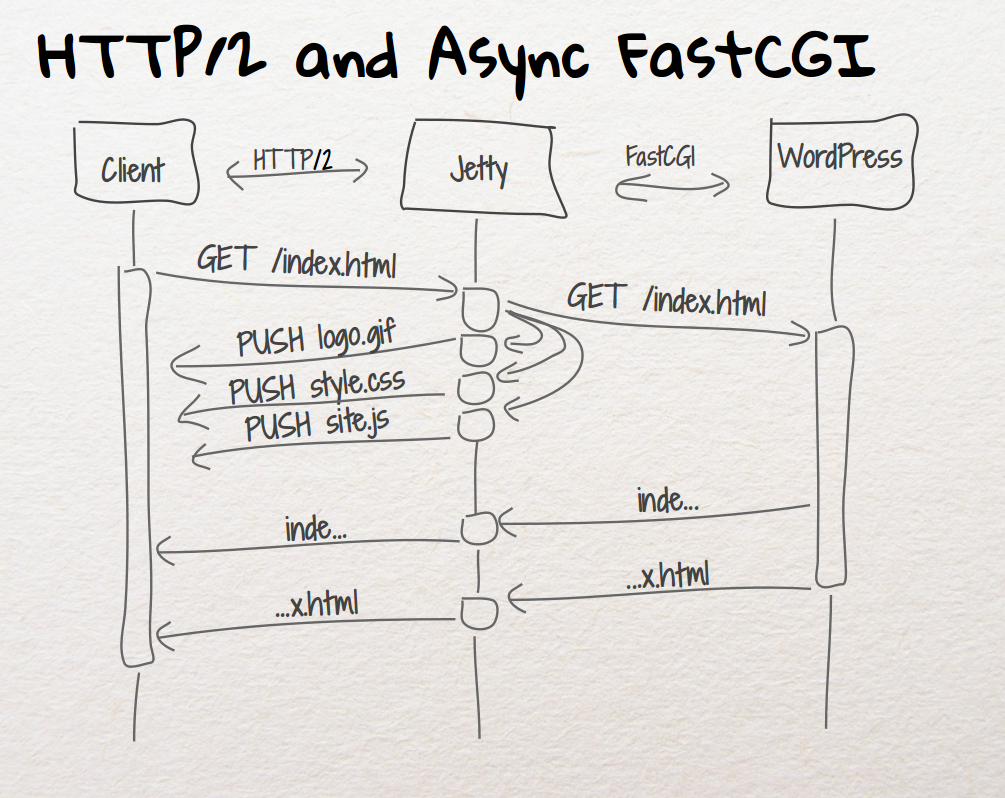
The first and foremost reason is that Jetty is the only server that supports SPDY Push.
SPDY Push is the biggest performance improvement you can make to your website, without a single change to the application being served, be it a Java web application or WordPress.
Watch our video that shows how the SPDY Push feature that Jetty provides makes a big performance difference.
The second reason is that SPDY version 2 is being deprecated really fast in favor of SPDY version 3 or greater.
Browsers will not speak SPDY/2 anymore, basically reverting your website to HTTPS behaviour, losing all the SPDY benefits if your server does not support SPDY 3 or greater.
As of the time of this writing, only servers like Apache or Jetty implement SPDY version 3 or later of the SPDY protocol, while Nginx only implements SPDY version 2.
At the Jetty Project we like to eat our own dogfood, so the blog site you are reading is WordPress served via Jetty.
If you’re using Firefox or Chrome, just open the browser network console, and you will see something like this:

As you can see from the response headers, the response is served by Jetty (Server: Jetty(9.1.0.v20131115)) from PHP (X-Powered-By: PHP/5.5.3-1ubuntu2).
Of course, since both Jetty 9.1’s server andHttpClientare fully asynchronous, you have a very scalable solution for your PHP-enabled website: currently the JVM that runs this very website only uses 25 MiB of heap.
And of course you get all the SPDY performance improvements over HTTP, along with Jetty’s unique SPDY Push features.
This is good for cloud vendors too, since they can run Jetty and expose PHP applications with a minimal amount of resources, high scalability, and unique features like SPDY Push.
FastCGI for Jetty is sponsored by Intalio. If you are interested in knowing more about how Jetty can speed up your website or how to setup your PHP web application in Jetty, contact us or send an email to Jesse McConnell.