Category: Asynchronous

  • Jetty 12 – Virtual Threads Support

    Executive Summary

    Virtual Threads, introduced in Java 19, are supported in Jetty 12, as they have been in Jetty 10 and Jetty 11 since 10.0.12 and 11.0.12, respectively.

    When virtual threads are supported by the JVM and enabled in Jetty (see embedded usage and standalone usage), applications are invoked using a virtual thread, which allows them to use simple blocking APIs, but with the scalability benefits of virtual threads.

    Introduction

    Virtual threads were introduced as a preview feature in Java 19 via JEP 425 and in Java 20 via JEP 436, and finally integrated as an official feature in Java 21 via JEP 444.

    Historically, the APIs provided to application developers, especially web application developers, were blocking APIs based on InputStream and OutputStream, or based on JDBC.
    These APIs are very simple to use, so applications are simple to develop, understand and troubleshoot.

    However, these APIs come with a cost: when a thread blocks, typically waiting for I/O or a contended lock, all the resources associated with that thread are retained, waiting for the thread to unblock and continue processing: the native thread and its native memory are retained, as well as network buffers, lock structures, etc.

    This means that blocking APIs are less scalable because they retain the resources they use.
    For example, if you have configured your server thread pool with 256 threads, and all are blocked, your server cannot process other requests until one of the blocked threads unblocks, limiting the server’s scalability.

    Furthermore, if you increase the server thread pool capacity, you will use more memory and likely require bigger hardware.

    Asynchronous/Reactive

    For these reasons, non-blocking asynchronous and reactive APIs have been introduced. The primary examples are the asynchronous I/O APIs introduced in Servlet 3.1 and reactive APIs provided by libraries such as RxJava and Spring’s Project Reactor, based on Reactive Streams.
    Unfortunately, REST APIs such as JAX-RS or Jakarta RESTful Web Services have not been (fully) updated with non-blocking APIs, so web applications that use REST are stuck with blocking APIs and scalability problems.

    Essential to note is that asynchronous and reactive APIs are more difficult to use, understand, and troubleshoot than blocking APIs, but are more scalable and typically achieve similar performances at a fraction of the resources. We have seen web applications that, when switched from blocking APIs to non-blocking APIs, reduced the threads usage from 1000+ to 10+.

    Virtual threads aim to be the best of both worlds: simple-to-use blocking APIs for developers, with the scalability of non-blocking APIs provided by the JVM.

    Jetty 12 Architecture

    The Jetty 12 architecture, at its core, is completely non-blocking and uses an AdaptiveExecutionStrategy (formerly known as “eat what you kill” which was covered in previous blogs here and here) to determine how to consume tasks.

    The key feature of AdaptiveExecutionStrategy is that it has a strong preference for consuming tasks in the same thread that produces them, so they are executed with a hot CPU cache, without parallel slowdown and no context-switch latency, yet avoids the risk of the server exhausting its thread pool.

    Simplifying a bit, each task is marked either as blocking or non-blocking; AdaptiveExecutionStrategy looks at the task and at how many threads are available to decide how to consume the task.

    If the task is non-blocking, the current thread runs it immediately.
    Otherwise, if no other threads are available to continue producing tasks, the current thread takes over the production of tasks and gives the tasks to an Executor, where they are likely queued and executed later by different threads.

    Virtual Threads Integration

    This architecture made it easy to integrate virtual threads in Jetty: when virtual threads are supported by the JVM and Jetty’s virtual threads support is enabled (see embedded usage and standalone usage), AdaptiveExecutionStrategy consumes a blocking task by offering the task to the virtual thread Executor rather than the native thread Executor, so that a newly spawned virtual thread runs the blocking task.

    That’s it.

    As a Servlet Container implementation, Jetty calls Servlets assuming they will use blocking APIs, so the task that invokes the Servlet is a blocking task.
    When virtual threads are supported and enabled, the thread that calls Servlet Filters and eventually the HttpServlet.service(...) method is a virtual thread.

    For non-blocking tasks, it is more efficient to have them run by the same native thread that created them; it is only for blocking tasks that you may want to use virtual threads.

    Conclusions

    Jetty’s AdaptiveExecutionStrategy allows the best of all worlds.
    Jetty provides a fast scalable asynchronous implementation, which avoids any possible limitations of virtual threads, whilst giving applications the full benefits of virtual threads. 

    Jetty deals with complex asynchronous concerns, so you don’t have to!

  • Less is More? Evolving the Servlet API!

    With the release of the Servlet API 5.0 as part of Eclipse Jakarta EE 9.0 the standardization process has completed its move from the now-defunct Java Community Process (JCP) to being fully open source at the Eclipse Foundation, including the new Eclipse EE Specification Process (JESP) and the transition of the APIs from the javax.* to the jakarta.* namespace.  The move represents a huge amount of work from many parties, but ultimately it was all meta work, in that Servlet 5.0 API is identical to the 4.0 API in all regards but name, licenses, and process, i.e. nothing functional has changed.

    But now with the transition behind us, the Servlet API project is now free to develop the standard into a 5.1 or 6.0 release.  So in this blog, I will put forward my ideas for how we should evolve the Servlet specification, specifically that I think that before we add new features to the API, it is time to remove some.

    Backward Compatibility

    Version 1.0  was created in 1997 and it is amazing that over 2 decades later, a Servlet written against that version should still run in the very latest EE container.  So why with such a great backward compatible record should we even contemplate introducing breaking changes to future Servlet API specification?  Let’s consider some of the reasons that a developer might choose to use EE Servlets over other available technologies:

    Performance
    Not all web applications need high performance and when they do, it is seldom the Servlet container itself that is the bottleneck.   Yet pure performance remains a key selection criteria for containers as developers either wish to have the future possibility of high request rates or need every spare cycle available to help their application meet an acceptable quality of service. Also there is the environmental impact of the carbon foot print of unnecessary cycles wasted in the trillion upon trillions of HTTP requests executed.   Thus application containers always compete on performance, but unfortunately many of the features added over the years have had detrimental affects to over-all performance as they often break the “No Taxation without Representation” principle: that there should not be a cost for all requests for a feature only used by <1%.
    Features
    Developers seek to have the current best practice features available in their container.   This may be as simple as changing from byte[] to ByteBuffers or Collections, or it may be more fundamental integration of things such as dependency injection, coding by convention, asynchronous, reactive, etc.  The specification has done a reasonable job supporting such features over the years, but mistakes have been made and some features now clash, causing ambiguity and complexity. Ultimately feature integration can be an N2 problem, so reducing or simplifying existing features can greatly reduce the complexity of introducing new features.
    Portability
    The availability of multiple implementations of the Servlet specification is a key selling point.  However the very same issues of poor integration of many features has resulted in too many dark corners of the specification where the expected behavior of a container is simply not defined, so portability is by no means guaranteed.   Too often we find ourselves needing to be bug-for-bug compatible with other implementations rather than following the actual specification.
    Familiarity
    Any radical departure from the core Servlet API will force developers away from what  they know and to evaluate alternatives.  But there are many non core features in the API and this blog will make the case that there are some features which can can be removed and/or simplified without hardly being noticed by the bulk of applications.  My aim with this blog is that your typical Servlet developer will think: “why is he making such a big fuss about something I didn’t know was there”, whilst your typical Servlet container implementer will think “Exactly! that feature is such a PITA!!!”.

    If the Servlet API is to continue to be relevant, then it needs to be able to compete with start-of-the-art HTTP servers that do not support decades of EE legacy.  Legacy can be both a strength and a weakness, and I believe now is the time to focus on the former.  The namespace break from java.* to jakarta.* has already introduced a discontinuity in backward compatibility.   Keeping 5.0 identical in all but name to 4.0 was the right thing to do to support automatic porting of applications.  However, it has also given developers a reason to consider alternatives, so now is the time to act to ensure that Servlet 6.0 a good basis for the future of EE Servlets.

    Getting Cross about Cross-Context Dispatch

    Let’s just all agree upfront, without going into the details, that cross-context dispatch is a bad thing. For the purposes of the rest of this blog, I’m ignoring the many issues of cross-context dispatch.  I’ll just say that every issue I will discuss below becomes even more complex when cross-context dispatch is considered, as it introduces: additional class loaders; different session values in the same session ID space; different authentication realms; authorization bypass. Don’t even get me started on the needless mind-bending complexities of a context that forwards to another then forwards back to the original…

    Modern web applications are now often broken up into many microservices, so the concept of one webapp invoking another is not in itself bad, but the idea of those services being co-located in the same container instance is not very general nor flexible assumption. By all means, the Servlet API should support a mechanism to forward or include other resources, but ideally, this should be done in a way that works equally for co-resident, co-located, and remote resources.

    So let’s just assume cross-context dispatch is already dead.

    Exclude Include

    The concept of including another resource in a response should be straight forward, but the specification of RequestDispatcher.include(...) is just bizarre!

    @WebServlet(urlPatterns = {"/servletA/*"})
    public static class ServletA extends HttpServlet
    {
        @Override protected void doGet(HttpServletRequest request,
                                       HttpServletResponse response) throws IOException
        {
            request.getRequestDispatcher("/servletB/infoB").include(request, response);
        }
    }

    The ServletA above includes ServletB in its response.  However, whilst within ServletB any calls to getServletPath() or getPathInfo(),will still return the original values used to call ServletA, rather than the “/servletB” or “/infoB”  values for the target Servlet (as is done for a call to  forward(...)).  Instead the container must set an ever-growing list of Request attributes to describe the target of the include and any non trivial Servlet that acts on the actual URI path must do something like:

    public boolean doGet(HttpServletRequest request, HttpServletResponse response)
        throws ServletException, IOException
    {
        String servletPath;
        String pathInfo;
        if (request.getAttribute(RequestDispatcher.INCLUDE_REQUEST_URI) != null)
        {
            servletPath = (String)
                request.getAttribute(RequestDispatcher.INCLUDE_SERVLET_PATH);
            pathInfo = (String)
                request.getAttribute(RequestDispatcher.INCLUDE_PATH_INFO);
        }
        else
        {
            servletPath = request.getServletPath();
            pathInfo = request.getPathInfo();
        }
        String pathInContext = URIUtil.addPaths(servletPath, pathInfo);
        // ...
    }

    Most Servlets do not do this, so they are unable to be correctly be the target of an include.  For the Servlets that do correctly check, they are more often than not wasting CPU cycles needlessly for the vast majority of requests that are not included.

    Meanwhile,  the container itself must set (and then reset) at least 5 attributes, just in case the target resource might lookup one of them. Furthermore, the container must disable most of the APIs on the response object during an include, to prevent the included resource from setting the headers. So the included Servlet must be trusted to know that it is being included in order to serve the correct resource, but is then not trusted to not call APIs that are inconsistent with that knowledge. Servlets should not need to know the details of how they were invoked in order to generate a response. They should just use the paths and parameters of the request passed to them to generate a response, regardless of how that response will be used.

    Ultimately, there is no need for an include API given that the specification already has a reasonable forward mechanism that supports wrapping. The ability to include one resource in the response of another can be provided with a basic wrapper around the response:

    @WebServlet(urlPatterns = {"/servletA/*"})
    public static class ServletA extends HttpServlet
    {
        @Override
        protected void doGet(HttpServletRequest request,
                             HttpServletResponse response) throws IOException
        {
            request.getRequestDispatcher("/servletB/infoB")
                .forward(request, new IncludeResponseWrapper(response));
        }
    }

    Such a response wrapper could also do useful things like ensuring the included content-type is correct and better dealing with error conditions rather than ignoring an attempt to send a 500 status. To assist with porting, the include can be deprecated it’s implementation replaced with a request wrapper that reinstates the deprecated request attributes:

    @Deprecated
    default void include(ServletRequest request, ServletResponse response)
        throws ServletException, IOException
    {
        forward(new Servlet5IncludeAttributesRequestWrapper(request),
                new IncludeResponseWrapper(response));
    }

    Dispatch the DispatcherType

    The inclusion of the method Request.getDispatcherType()in the Servlet API is almost an admission of defeat that the specification got it wrong in so many ways that required a Servlet to know how and/or why it is being invoked in order to function correctly. Why must a Servlet know its DispatcherType? Probably so it knows it has to check the attributes for the corresponding values? But what if an error page is generated asynchronously by including a resource that forwards to another? In such a pathological case, the request will contain attributes for ERROR, ASYNC, and FORWARD, yet the type will just be FORWARD.

    The concept of DispatcherType should be deprecated and it should always return REQUEST.  Backward compatibility can be supported by optionally applying a wrapper that determines the deprecated DispatcherType only if the method is called.

    Unravelling Wrappers

    A key feature that really needs to be revised is 6.2.2 Wrapping Requests and Responses, introduced in Servlet 2.3. The core concept of wrappers is sound, but the requirement of Wrapper Object Identity (see Object Identity Crisis below) has significant impacts. But first let’s look at a simple example of a request wrapper:

    public static class ForcedUserRequest extends HttpServletRequestWrapper
    {
        private final Principal forcedUser;
        public ForcedUserRequest(HttpServletRequest request, Principal forcedUser)
        {
            super(request);
            this.forcedUser = forcedUser;
        }
        @Override
        public Principal getUserPrincipal()
        {
            return forcedUser;
        }
        @Override
        public boolean isUserInRole(String role)
        {
            return forcedUser.getName().equals(role);
        }
    }

    This request wrapper overrides the existing getUserPrincipal() and isUserInRole(String)methods to forced user identity.  This wrapper can be applied in a filter or in a Servlet as follows:

    @WebServlet(urlPatterns = {"/servletA/*"})
    public static class ServletA extends HttpServlet
    {
        @Override
        protected void doGet(HttpServletRequest request, HttpServletResponse response)
            throws ServletException, IOException
        {
            request.getServletContext()
                .getRequestDispatcher("/servletB" + req.getPathInfo())
                .forward(new ForcedUserRequest(req, new UserPrincipal("admin")),
                         response);
        }
    }

    Such wrapping is an established pattern in many APIs and is mostly without significant problems. For Servlets there are some issues: it should be better documented if  the wrapped user identity is propagated if ServletB makes any EE calls (I think no?);  some APIs have become too complex to sensibly wrap (e.g HttpInputStream with non-blocking IO). But even with these issues, there are good safe usages for this wrapping to override existing methods.

    Object Identity Crisis!

    The Servlet specification allows for wrappers to do more than just override existing methods! In 6.2.2, the specification says that:

    “… the developer not only has the ability to override existing methods on the request and response objects, but to provide new API… “

    So the example above could introduce new API to access the original user principal:

    public static class ForcedUserRequest extends HttpServletRequestWrapper
    {
        // ... getUserPrincipal & isUserInRole as above
        public Principal getOriginalUserPrincipal()
        {
            return super.getUserPrincipal();
        }
        public boolean isOriginalUserInRole(String role)
        {
            return super.isUserInRole(role);
        }
    }
    

    In order for targets to be able to use these new APIs then they must be able to downcast the passed request/response to the known wrapper type:

    @WebServlet(urlPatterns = {"/servletB/*"})
    public static class ServletB extends HttpServlet
    {
        @Override
        protected void doGet(HttpServletRequest req, HttpServletResponse resp)
            throws ServletException, IOException
        {
            MyWrappedRequest myr = (MyWrappedRequest)req;
            resp.getWriter().printf("user=%s orig=%s wasAdmin=%b%n",
                req.getUserPrincipal(),
                myr.getOriginalUserPrincipal(),
                myr.isOriginalUserInRole("admin"));
        }
    }

    This downcast will only work if the wrapped object is passed through the container without any further wrapping, thus the specification requires “wrapper object identity”:

    … the container must ensure that the request and response object that it passes to the next entity in the filter chain, or to the target web resource if the filter was the last in the chain, is the same object that was passed into the doFilter method by the calling filter. The same requirement of wrapper object identity applies to the calls from a Servlet or a filter to RequestDispatcher.forward  or  RequestDispatcher.include, when the caller wraps the request or response objects.

    This “wrapper object identity” requirement means that the container is unable to itself wrap requests and responses as they are passed to filters and servlets. This restriction has, directly and indirectly, a huge impact on the complexity, efficiency, and correctness of Servlet container implementations, all for very dubious and redundant benefits:

    Bad Software Components
    In the example of ServletB above, it is a very bad software component as it cannot be invoked simply by respecting the signature of its methods. The caller must have a priori knowledge that the passed request will be downcast and any other caller will be met with a ClassCastException. This defeats the whole point of an API specification like Servlets, which is to define good software components that can be variously assembled according to their API contracts.
    No Multiple Concerns
    It is not possible for multiple concerns to wrap request/responses. If another filter applies its own wrappers, then the downcast will fail. The requirement for “wrapper object identity” requires the application developer to have total control over all aspects of the application, which can be difficult with discovered web fragments and ServletContainerInitializers.
    Mutable Requests
    By far the biggest impact of “wrapper object identity” is that it forces requests to be mutable! Since the container is not allowed to do its own wrapping within RequestDispatcher.forward(...) then the container must make the original request object mutable so that it changes the value returned from getServletPath() to reflect the target of the dispatch.  It is this impact that has significant impacts on complexity, efficiency, and correctness:

    • Mutating the underlying request makes the example implementation of isOriginalUserInRole(String) incorrect because it calls super.isUserInRole(String) whose result can be mutated if the target Servlet has a run-as configuration.  Thus this method will inadvertently return the target rather than the original role.
    • There is the occasional need for a target Servlet to know details of the original request (often for debugging), but the original request can mutate so it cannot be used. Instead, an ever-growing list of Request attributes that must be set and then cleared on the original request attributes, just in case of the small chance that the target will need one of them.  A trivial forward of a request can thus require at least 12 Map operations just to make available the original state, even though it is very seldom required. Also, some aspects of the event history of a request are not recoverable from the attributes: the isUserInRolemethod; the original target of an include that does another include.
    • Mutable requests cannot be safely passed to asynchronous processes, because there will be a race between the other thread call to a request method and any mutations required as the request propagates through the Servlet container (see the “Off to the Races” example below).  As a result, asynchronous applications SHOULD copy all the values from the request that they MIGHT later need…. or more often than not they don’t, and many work by good luck, but may fail if timing on the server changes.
    • Using immutable objects can have significant benefits by allowing the JVM optimizer and GC to have knowledge that field values will not change.   By forcing the containers to use mutable request implementations, the specification removes the opportunity to access these benefits. Worse still, the complexity of the resulting request object makes them rather heavy weight and thus they are often recycled in object pools to save on the cost of creation. Such pooled objects used in asynchronous environments can be a recipe for disaster as asynchronous processes may reference a request object after it has been recycled into another request.
    Unnecessary
    New APIs can be passed on objects set as request attribute values that will pass through multiple other wrappers, coexist with other new APIs in attributes and do not require the core request methods to have mutable returns.

    The “wrapper object identity” requirement has little utility yet significant impacts on the correctness and performance of implementations. It significantly impairs the implementation of the container for a feature that can be rendered unusable by a wrapper applied by another filter.  It should be removed from Servlet 6.0 and requests passed in by the container should be immutable.

    Asynchronous Life Cycle

    A bit of history

    Jetty continuations were a non-standard feature introduced in Jetty-6 (around 2005) to support thread-less waiting for asynchronous events (e.g. typically another HTTP request in a chat room). Because the Servlet API had not been designed for thread-safe access from asynchronous processes, the continuations feature did not attempt to let arbitrary threads call the Servlet API.  Instead, it has a suspend/resume model that once the asynchronous wait was over, the request was re-dispatched back into the Servlet container to generate a response, using the normal blocking Servlet API from a well-defined context.

    When the continuation feature was standardized in the Servlet 3.0 specification, the Jetty suspend/resume model was supported with the APIs ServletRequest.startAsync() and AsyncContext.dispatch() methods.  However (against our strongly given advice), a second asynchronous model was also enabled, as represented by ServletRequest.startAsync() followed by AsyncContext.complete().  With the start/complete model, instead of generating a response by dispatching a container-managed thread, serialized on the request, to the Servlet container, arbitrary asynchronous threads could generate the response by directly accessing the request/response objects and then call the AsyncContext.complete() method when the response had been fully generated to end the cycle.   The result is that the entire API, designed not to be thread safe, was now exposed to concurrent calls. Unfortunately there was (and is) very little in the specification to help resolve the many races and ambiguities that resulted.

    Off to the Races

    The primary race introduced by start/complete is that described above caused by mutable requests that are forced by “wrapper object identity”. Consider the following asynchronous Servlet:

    @WebServlet(urlPatterns = {"/async/*"}, asyncSupported = true)
    @RunAs("special")
    public static class AsyncServlet extends HttpServlet
    {
        @Override
        protected void doGet(HttpServletRequest request, HttpServletResponse response)
            throws ServletException, IOException
        {
            AsyncContext async = request.startAsync();
            PrintWriter out = response.getWriter();
            async.start( () ->
            {
                response.setStatus(HttpServletResponse.SC_OK);
                out.printf("path=%s special=%b%n",
                           request.getServletPath(),
                           request.isUserInRole("special"));
                async.complete();
            });
        }
    }

    If invoked via a RequestDispatcher.forward(...), then the result produced by this Servlet is a race: will the thread dispatched to execute the lambda execute before or after the thread returns from the `doGet` method (and any applied filters) and the pre-forward values for the path and role are restored? Not only could the path and role be reported either for the target or caller, but the race could even split them so they are reported inconsistently.  To avoid this race, asynchronous Servlets must copy any value that they may use from the request before starting the asynchronous thread, which is needless complexity and expense. Many Servlets do not actually do this and just rely on happenstance to work correctly.

    This problem is the result of  the start/complete lifecycle of asynchronous Servlets permitting/encouraging arbitrary threads to call the existing APIs that were not designed to be thread-safe.  This issue is avoided if the request object passed to doGet is immutable and if it is the target of a forward, it will always act as that target. However, there are other issues of the asynchronous lifecycle that cannot be resolved just with immutability.

    Out of Time

    The example below is a very typical race that exists in many applications between a timeout and asynchronous processing:

    @Override
    protected void doGet(HttpServletRequest request,
                         HttpServletResponse response) throws IOException
    {
        AsyncContext async = request.startAsync();
        PrintWriter out = response.getWriter();
        async.addListener(new AsyncListener()
        {
            @Override
            public void onTimeout(AsyncEvent asyncEvent) throws IOException
            {
                response.setStatus(HttpServletResponse.SC_BAD_GATEWAY);
                out.printf("Request %s timed out!%n", request.getServletPath());
                out.printf("timeout=%dms%n ", async.getTimeout());
                async.complete();
            }
        });
        CompletableFuture<String> logic = someBusinessLogic();
        logic.thenAccept(answer ->
        {
            response.setStatus(HttpServletResponse.SC_OK);
            out.printf("Request %s handled OK%n", request.getServletPath());
            out.printf("The answer is %s%n", answer);
            async.complete();
        });
    }

    Because the handling of the result of the business logic may be executed by a non-container-managed thread, it may run concurrently with the timeout callback. The result can be an incorrect status code and/or the response content being interleaved. Even if both lambdas grab a lock to mutually exclude each other, the results are sub-optimal, as both will eventually execute and one will ultimately throw an IllegalStateException, causing extra processing and a spurious exception that may confuse developers/deployers.

    The current specification of the asynchronous life cycle is the worst of both worlds for the implementation of the container. On one hand, they must implement the complexity of request-serialized events, so that for a given request there can only be a single container-managed thread in service(...), doFilter(...), onWritePossible(), onDataAvailable(), onAllDataRead()and onError(), yet on the other hand an arbitrary application thread is permitted to concurrently call the API, thus requiring additional thread-safety complexity. All the benefits of request-serialized threads are lost by the ability of arbitrary other threads to call the Servlet APIs.

    Request Serialized Threads

    The fix is twofold: firstly make more Servlet APIs immutable (as discussed above) so they are safe to call from other threads;  secondly and most importantly, any API that does mutate state should only be able to be called from request-serialized threads!   The latter might seem a bit draconian as it will make the lambda passed to thenAccept in the example above throw an IllegalStateException when it tries to setStatus(int) or call complete(), however, there are huge benefits in complexity and correctness and only some simple changes are needed to rework existing code.

    Any code running within a call to service(...), doFilter(...), onWritePossible(), onDataAvailable(), onAllDataRead()and onError() will already be in a request-serialized thread, and thus will require no change. It is only code executed by threads managed by other asynchronous components (e.g. the lambda passed to thenAccept() above) that need to be scoped. There is already the method AsyncContext.start(Runnable) that allows a non-container thread to access the context (i.e. classloader) associated with the request. An additional similar method AsyncContext.dispatch(Runnable) can be provided that not only scopes the execution but mutually excludes it and serializes it against any call to the methods listed above and any other dispatched Runnable. The Runnables passed may be executed within the scope of the dispatch call if possible (making the thread momentarily managed by the container and request serialized) or scheduled for later execution.  Thus calls to mutate the state of a request can only be made from threads that are serialized.

    To make accessing the dispatch(Runnable) method more convenient, an executor can be provided with AsyncContext.getExecutor() which provides the same semantic.  The example above can now be simply updated:

    @Override
    protected void doGet(HttpServletRequest request,
                         HttpServletResponse response) throws IOException
    {
        AsyncContext async = request.startAsync();
        PrintWriter out = response.getWriter();
        async.addListener(new AsyncListener()
        {
            @Override
            public void onTimeout(AsyncEvent asyncEvent) throws IOException
            {
                response.setStatus(HttpServletResponse.SC_BAD_GATEWAY);
                out.printf("Request timed out after %dms%n ", async.getTimeout());
                async.complete();
            }
        });
        CompletableFuture<String> logic = someBusinessLogic();
        logic.thenAcceptAsync(answer ->
        {
            response.setStatus(HttpServletResponse.SC_OK);
            out.printf("The answer is %s%n", answer);
            async.complete();
        }, async.getExecutor());
    }

    Because the AsyncContext.getExecutor() is used to invoke the business logic consumer, then the timeout and business logic response methods are mutually excluded. Moreover, because they are serialized by the container, the request state can be checked between each, so that if the business logic has completed the request, then the timeout callback will never be called, even if the underlying timer expires while the response is being generated. Conversely, if the business logic result is generated after the timeout, then the lambda to generate the response will never be called.  Because both of the tasks in this example call complete, then only one of them will ever be executed.

    And Now You’re Complete

    In the example below, a non-blocking read listener has been set on the request input stream, thus a callback to onDataAvailable() has been scheduled to occur at some time in the future.  In parallel, an asynchronous business process has been initiated that will complete the response:

    @Override
    protected void doGet(HttpServletRequest request, HttpServletResponse response) throws IOException
    {
        AsyncContext async = request.startAsync();
        request.getInputStream().setReadListener(new MyReadListener());
        CompletableFuture<String> logicB = someBusinessLogicB();
        PrintWriter out = response.getWriter();
        logicB.thenAcceptAsync(b ->
        {
            out.printf("The answer for %s is B=%s%n", request.getServletPath(), b);
            async.complete();
        }, async.getExecutor());
    }

    The example uses the proposed APIs above so that any call to complete is mutually excluded and serialized with the call to doGet and onDataAvailable(...). Even so, the current spec is unclear if the complete should prevent any future callback to onDataAvailable(...) or if the effect of complete() should be delayed until the callback is made (or times out). Given that the actions can now be request-serialized, the spec should require that once a request serialized thread that has called complete returns, then the request cycle is complete and there will be no other callbacks other than onComplete(...), thus cancelling any non-blocking IO callbacks.

    To Be Removed

    Before extending the Servlet specification, I believe the following existing features should be removed or deprecated:

    • Cross context dispatch deprecated and existing methods return null.  Once a request is matched to a context, then it will only ever be associated with that context and the getServletContext() method will return the same value no matter what state the request is in.
    • The “Wrapper Object Identity” requirement is removed and the request object will be required to be immutable in regards to the methods affected by a dispatch and may be referenced by asynchronous threads.
    • The RequestDispatcher.include(...) is deprecated and replaced with utility response wrappers.  The existing API can be deprecated and its implementation changed to use a request wrapper to simulate the existing attributes.
    • The special attributes for FORWARD, INCLUDE, ASYNC are removed from the normal dispatches.  Utility wrappers will be provided that can simulate these attributes if needed for backward compatibility.
    • The getDispatcherType() method is deprecated and returns REQUEST, unless a utility wrapper is used to replicate the old behavior.
    • Servlet API methods that mutate state will only be callable from request-serialized container-managed threads and will otherwise throw IllegalStateException. New AsyncContext.dispatch(Runnable) and AsyncContext.getExecutor() methods will provide access to request-serialization for arbitrary threads/lambdas/Runnables

    With these changes, I believe that many web applications will not be affected and most of the remainder could be updated with minimal effort. Furthermore, utility filters can be provided that apply wrappers to obtain almost all deprecated behaviors other than Wrapper Object Identity. In return for the slight break in backward compatibility, the benefit of these changes would be significant simplifications and efficiencies of the Servlet container implementations. I believe that only with such simplifications can we have a stable base on which to build new features into the Servlet specification. If we can’t take out the cruft now, then when?

    The plan is to follow this blog up with another proposing some more rationalisation of features (I’m looking at you sessions and authentication), before another blog proposing some new features an future directions.
  • Introducing Jetty Load Generator

    The Jetty Project just released the Jetty Load Generator, a Java 11+ library to load-test any HTTP server, that supports both HTTP/1.1 and HTTP/2.
    The project was born in 2016, with specific requirements. At the time, very few load-test tools had support for HTTP/2, but Jetty’s HttpClient did. Furthermore, few tools supported web-page like resources, which were important to model in order to compare the multiplexed HTTP/2 behavior (up to ~100 concurrent HTTP/2 streams on a single connection) against the HTTP/1.1 behavior (6-8 connections). Lastly, we were more interested in measuring quality of service, rather than throughput.
    The Jetty Load Generator generates requests asynchronously, at a specified rate, independently from the responses. This is the Jetty Load Generator core design principle: we wanted the request generation to be constant, and measure response times independently from the request generation. In this way, the Jetty Load Generator can impose a specific load on the server, independently of the network round-trip and independently of the server-side processing time. Adding more load generators (on the same machine if it has spare capacity, or using additional machines) will allow the load against the server to increase linearly.
    Using this core principle, you can setup the load testing by having N load generator loaders that impose the load on the server, and 1 load generator probe that imposes a very light load and measures response times.
    For example, you can have 4 loaders that impose 20 requests/s each, for a total of 80 requests/s seen by the server. With this load on the server, what would be the experience, in terms of response times, of additional users that make requests to the server? This is exactly what the probe measures.
    If the load on the server is increased to 160 requests/s, what would the probe experience? The same response times? Worse? And what are the probe response times if the load on the server is increased to 240 requests/s?
    Rather than trying to measure some form of throughput (“what is the max number of requests/s the server can sustain?”), the Jetty Load Generator measures the quality of service seen by the probe, as the load on the server increases. This is, in practice, what matters most for HTTP servers: knowing that, when your server has a load of 1024 requests/s, an additional user can still see response times that are acceptable. And knowing how the quality of service changes as the load increases.
    The Jetty Load Generator builds on top of Jetty’s HttpClient features, and offers:

    • A builder-style Java API, to embed the load generator into your own code and to have full access to all events emitted by the load generator
    • A command-line tool, similar to Apache’s ab or wrk2, with histogram reporting, for ease of use, scripting, and integration with CI servers.

    Download the latest command-line tool uber-jar from: https://repo1.maven.org/maven2/org/mortbay/jetty/loadgenerator/jetty-load-generator-starter/

    $ cd /tmp
    $ curl -O https://repo1.maven.org/maven2/org/mortbay/jetty/loadgenerator/jetty-load-generator-starter/1.0.2/jetty-load-generator-starter-1.0.2-uber.jar
    

    Use the --help option to display the available command line options:

    $ java -jar jetty-load-generator-starter-1.0.2-uber.jar --help
    

    Then run it, for example:

    $ java -jar jetty-load-generator-starter-1.0.2-uber.jar --scheme https --host your_server --port 443 --resource-rate 1 --iterations 60 --display-stats
    

    You will obtain an output similar to the following:

    ----------------------------------------------------
    -------------  Load Generator Report  --------------
    ----------------------------------------------------
    https://your_server:443 over http/1.1
    resource tree     : 1 resource(s)
    begin date time   : 2021-02-02 15:38:39 CET
    complete date time: 2021-02-02 15:39:39 CET
    recording time    : 59.657 s
    average cpu load  : 3.034/1200
    histogram:
    @                     _  37 ms (0, 0.00%)
    @                     _  75 ms (0, 0.00%)
    @                     _  113 ms (0, 0.00%)
    @                     _  150 ms (0, 0.00%)
    @                     _  188 ms (0, 0.00%)
    @                     _  226 ms (0, 0.00%)
    @                     _  263 ms (0, 0.00%)
    @                     _  301 ms (0, 0.00%)
                       @  _  339 ms (46, 76.67%) ^50%
       @                  _  376 ms (7, 11.67%) ^85%
      @                   _  414 ms (5, 8.33%) ^95%
    @                     _  452 ms (1, 1.67%)
    @                     _  489 ms (0, 0.00%)
    @                     _  527 ms (0, 0.00%)
    @                     _  565 ms (0, 0.00%)
    @                     _  602 ms (0, 0.00%)
    @                     _  640 ms (0, 0.00%)
    @                     _  678 ms (0, 0.00%)
    @                     _  715 ms (0, 0.00%)
    @                     _  753 ms (1, 1.67%) ^99% ^99.9%
    response times: 60 samples | min/avg/50th%/99th%/max = 303/335/318/753/753 ms
    request rate (requests/s)  : 1.011
    send rate (bytes/s)        : 189.916
    response rate (responses/s): 1.006
    receive rate (bytes/s)     : 41245.797
    failures          : 0
    response 1xx group: 0
    response 2xx group: 60
    response 3xx group: 0
    response 4xx group: 0
    response 5xx group: 0
    ----------------------------------------------------
    

    Use the Jetty Load Generator for your load testing, and report comments and issues at https://github.com/jetty-project/jetty-load-generator. Enjoy!

  • Do Looms Claims Stack Up? Part 2: Thread Pools?

    “Project Loom aims to drastically reduce the effort of writing, maintaining, and observing high-throughput concurrent applications that make the best use of available hardware. … The problem is that the thread, the software unit of concurrency, cannot match the scale of the application domain’s natural units of concurrency — a session, an HTTP request, or a single database operation. …  Whereas the OS can support up to a few thousand active threads, the Java runtime can support millions of virtual threads. Every unit of concurrency in the application domain can be represented by its own thread, making programming concurrent applications easier. Forget about thread-pools, just spawn a new thread, one per task.” – Ron Pressler, State of Loom, May 2020

    In this series of blogs, we are examining the new Loom virtual thread features now available in OpenJDK 16 early access releases. In part 1 we saw that Loom’s claim of 1,000,000 virtual threads was true, but perhaps a little misleading, as that only applies to threads with near-empty stacks.  If threads actually have deep stacks, then the achieved number of virtual threads is bound by memory and is back to being the same order of magnitude as kernel threads.  In this part, we will further examine the claims and ramifications of Project Loom, specifically if we can now forget about Thread Pools. Spoiler: Cheap threads can do expensive things!
    All the code from this blog is available in our loom-trial project and has been run on my dev machine (Intel® Core™ i7-6820HK CPU @ 2.70GHz × 8, 32GB memory,  Ubuntu 20.04.1 LTS 64-bit, OpenJDK Runtime Environment (build 16-loom+9-316)) with no specific tuning and default settings unless noted otherwise. 

    Matching the scale?

    Project Loom makes the claim that applications need threads because kernel threads “cannot match the scale of the application domain’s natural units of concurrency”!
    Really???  We’ve seen that without tuning, we can achieve 32k of either type of thread on my laptop.  We think it would be fair to assume that with careful tuning, that could be stretched to beyond 100k for either technology.  Is this really below the natural scale of most applications?  How many applications have a natural scale of more than 32k simultaneous parallel tasks?  Don’t get me wrong, there are many apps that do exceed those scales and Jetty has users that put an extra 0 on that, but they are the minority and in reality very few applications are ever going to see that demand for concurrency.
    So if the vast majority of applications would be covered by blocking code with a concurrency of 32k, then what’s the big deal? Why do those apps need Loom? Or, by the same argument, why would they need to be written in asynchronous style?
    The answer is that you rarely see any application deployed with 10,000s of threads; instead, threads are limited by a thread pool, typically to 100s or 1000s of threads.  The default thread pool size in jetty is 200, which we sometimes see increased to 1000s, but we have never seen a 32k thread pool even though my un-tuned laptop could supposedly support it!
    So what’s going on? Why are thread pools typically so limited and what about the claim that Loom means we can “Forget about thread pools”?

    Why Thread Pools?

    One reason we are told that thread pools are used is because kernel threads are slow to start, thus having a bunch of them pre-started, waiting for a task in a pool improves latency.  Loom claims their virtual threads are much faster to start, so let’s test that with StartThreads, which reports:

    kStart(ns) ave:137,903 from:1,000 min:47,466 max:6,048,540
    vStart(ns) ave: 10,881 from:1,000 min: 4,648 max:  486,078

    So that claim checks out. Virtual threads start an order of magnitude faster than kernel threads.  If start time was the only reason for thread pools, then Loom’s claim of forgetting about thread pools would hold.
    But start time only explains why we have thread pools, but it doesn’t explain why thread pools are frequently sized far below the systems capacity for threads: 100s instead of 10,000s?  What is the reason that thread pools are sized as they are?

    Why Small Thread Pools?

    Giving a thread a task to do is a resource commitment. It is saying that a flow of control may proceed to consume CPU, memory and other resources that will be needed to run to completion or at least until a blocking point, where it can wait for those resources.  Most of those resources are not on the stack,  thus limiting the number of available threads is a way to limit a wide range of resource consumption and give quality of service:

    • If your back-end services can only handle 100s of simultaneous requests, then a thread pool with 100s of threads will avoid swamping them with too much load. If your JDBC driver only has 100 pooled connections, then 1,000,000 threads hammering on those connections or other locks are going to have a lot of contention.
    • For many applications a late response is a wrong response, thus it may well be better to handle 1000 tasks in a timely way with the 1001st task delayed, rather than to try to run all 1001 tasks together and have them all risk being late.
    • Graceful degradation under excess load.  Processing a task will need to use heap memory and if too much memory is demanded an OutOfMemeoryException is fatal for all java applications.  Limiting the number of threads is a coarse grained way of limiting a class of heap usage.  Indeed in part 1, we saw that it was heap memory that limited the number of virtual threads.

    Having a limited thread pool allows an application to be tested to that limit so that it can be proved that an application has the memory and other resources necessary to service all of those threads.  Traditional thinking has been that if the configured number of threads is insufficient for the load presented, then either the excess load must wait, or the application should start using asynchronous techniques to more efficiently use those threads (rather than increase the number of threads beyond the resource capacity of the machine).
    A limited thread pool is a coarse grained limit on all resources, not only threads.  Limiting the number of threads puts a limit on concurrent lock contention, memory consumption and CPU usage.

    Virtual Threads vs Thread Pool

    Having established that there might be some good reasons to use thread pools, let’s see if Loom gives us any good reasons not to use them?   So we have created a FakeDataBase class which simulates a JDBC connection pool of 100 connections with a semaphore and then in ManyTasks we run 100,000 tasks that do 2 selects and 1 insert to the database, with a small amount of CPU consumed both with and without the semaphore acquired.   The core of the thread pool test is:

     for (int i = 0; i < tasks; i++)
       pool.execute(newTask(latch));

    and this is compared against the Loom virtual thread code of:

     for (int i = 0 ; i < tasks; i++)
       Thread.builder().virtual().task(newTask(latch)).start();

    And the results are…. drum roll… pretty much the same for both types of thread:

    Pooled  K Threads 33,729ms
    Spawned V Threads 34,482ms

    The pooled kernel thread does appear to be consistently a little bit better, but this test is not that rigorous so let’s call it the same, which is kind of expected as the total duration is pretty much going to be primarily constrained by the concurrency of the database.
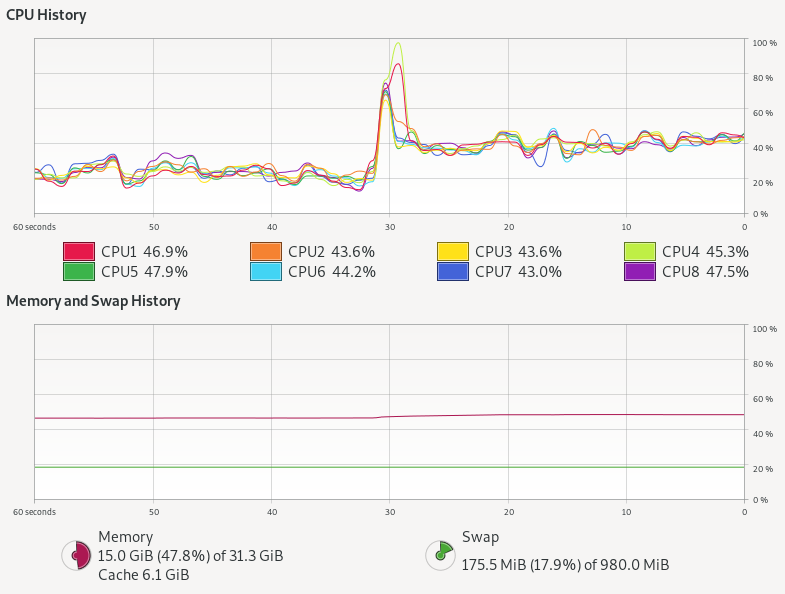
    So were there any difference at all?  Here is the system monitor graph during both runs: kernel threads with a pool are the left hand first period (60-30s) and then virtual threads after a change over peak (30s – 0s):

    Kernel threads with thread pool do not stress the CPU at all, but virtual threads alone use almost twice as much CPU! There is also a hint of more memory being used.
    The thread pool has 100k tasks in the thread pool queue, 100 kernel threads that take tasks, 100 at a time, and each task takes one of 100 semaphores permits 3 times, with little or no contention.
    The Loom approach has 100k independent virtual threads that each contend 3 times for the 100 semaphore permits, with up to 99,900 threads needing to be added then removed 3 times from the semaphore’s wake up queue.  The extra queuing for virtual threads could easily explain the excess CPU needed, but more investigation is needed to be definitive.
    However, tasks limited by a resource like JDBC are not really the highly concurrent tasks that Loom is targeted at.  To truly test Loom (and async), we need to look at a type of task that just won’t scale with blocking threads dispatched from a thread pool.

    Virtual Threads vs Async APIs

    One highly concurrent work load that we often see on Jetty is chat room style interaction (or games) written on CometD and/or WebSocket.  Such applications often have many 10,000s or even 100,000s of connections to the server that are mostly idle, waiting for a message to receive or an event to send. Currently we achieve these scales only by asynchronous threadless waiting, with all its ramifications of complex async APIs into the application needing async callbacks.  Luckily, CometD was originally written when there was only async servlets and not async IO, thus it still has the option to be deployed using blocking I/O reads and writes.  This gives it good potential to be a like for like comparison between async pooled kernel threads vs blocking virtual threads.
    However, we still have a concern that this style of application/load will not be suitable for Loom because each message to a chat room will fan out to the 10s, 100s or even 1000s of other users waiting in that room.  Thus a single read could result in many blocking write operations, which are typically done with deep stacks (parsing, framework, handling, marshalling, then writing) and other resources (buffers, locks etc). You can see in the following flame graph from a CometD load test using Loom virtual threads, that even with a fast client the biggest block of time is spent in the blue peak on the left, that is writing with deep stacks. It is this part of the graph that needs to scale if we have either more and/or slower clients:

    Jetty with CometD chat on Loom

    To fairly test Loom, it is not sufficient to just replace the limited pool of kernel threads with infinite virtual threads.  Jetty goes to lots of effort with its eat what you kill scheduling using reserved threads to ensure that whenever a selector thread calls a potentially blocking task, another selector thread has been executed.  We can’t just put Loom virtual threads on top of this, else it will be paying the cost and complexity of core Jetty plus the overheads of Loom.  Moreover, we have also learnt the risk of Thread Starvation that can result in highly concurrent applications if you defer important tasks (e.g. HTTP/2 flow control).  Since virtual threads can be postponed (potentially indefinitely) by CPU bound applications or the use of non-Loom-aware locks (such as the synchronized keyword), they are not suitable for all tasks within Jetty.
    Thus we think a better approach is to keep the core of Jetty running on kernel threads, but to spawn a virtual thread to do the actual work of reading, parsing, and calling the application and writing the response.  If we flag those tasks with InvocationType.NON_BLOCKING, then they will be called directly by the selector thread, with no executor overhead. These tasks can then spawn a new virtual thread to proceed with the reading, parsing,  handling, marshalling, writing and blocking.  Thus we have created the jetty-10.0.x-loom branch, to use this approach and hopefully give a good basis for fair comparisons.
    Our initial runs with our CometD benchmark with just 20 clients resulted in long GCs followed by out of memory failures! This is due to the usage of ThreadLocal for gathering latency statistics and each virtual thread was creating a latency capture data structure, only to use it once and then throw it away!  While this problem is solvable by changing the CometD benchmark code, it reaffirms that threads use resources other than stack and that Loom virtual threads are not a drop in replacement for kernel threads.
    We are aware that the handling of ThreadLocal is a well known problem in Loom, but until solved it may be a surprisingly hard problem to cope with, since you don’t typically know if a library your application depends on uses ThreadLocal or not.
    With the CometD benchmark modified to not use ThreadLocal, we can now take Loom/Jetty/CometD to a moderate number of clients (1000 which generated the flame graph above) with the following results:

    CLIENT: Async Jetty/CometD server
    ========================================
    Testing 1000 clients in 100 rooms, 10 rooms/client
    Sending 1000 batches of 10x50 bytes messages every 10000 µs
    Elapsed = 10015 ms
    - - - - - - - - - - - - - - - - - - - -
    Outgoing: Rate = 990 messages/s - 99 batches/s - 12.014 MiB/s
    Incoming: Rate = 99829 messages/s - 35833 batches/s(35.89%) - 26.352 MiB/s
                    @     _  3,898 µs (112993, 11.30%)
                       @  _  7,797 µs (141274, 14.13%)
                       @  _  11,696 µs (136440, 13.65%)
                       @  _  15,595 µs (139590, 13.96%) ^50%
                       @  _  19,493 µs (142883, 14.29%)
                      @   _  23,392 µs (130493, 13.05%)
                    @     _  27,291 µs (112283, 11.23%) ^85%
            @             _  31,190 µs (59810, 5.98%) ^95%
      @                   _  35,088 µs (12968, 1.30%)
     @                    _  38,987 µs (4266, 0.43%) ^99%
    @                     _  42,886 µs (2150, 0.22%)
    @                     _  46,785 µs (1259, 0.13%)
    @                     _  50,683 µs (910, 0.09%)
    @                     _  54,582 µs (752, 0.08%)
    @                     _  58,481 µs (567, 0.06%)
    @                     _  62,380 µs (460, 0.05%) ^99.9%
    @                     _  66,278 µs (365, 0.04%)
    @                     _  70,177 µs (232, 0.02%)
    @                     _  74,076 µs (82, 0.01%)
    @                     _  77,975 µs (13, 0.00%)
    @                     _  81,873 µs (2, 0.00%)
    Messages - Latency: 999792 samples
    Messages - min/avg/50th%/99th%/max = 209/15,095/14,778/35,815/78,184 µs
    Messages - Network Latency Min/Ave/Max = 0/14/78 ms
    SERVER: Async Jetty/CometD server
    ========================================
    Operative System: Linux 5.8.0-33-generic amd64
    JVM: Oracle Corporation OpenJDK 64-Bit Server VM 16-ea+25-1633 16-ea+25-1633
    Processors: 12
    System Memory: 89.26419% used of 31.164349 GiB
    Used Heap Size: 73.283676 MiB
    Max Heap Size: 2048.0 MiB
    - - - - - - - - - - - - - - - - - - - -
    Elapsed Time: 10568 ms
       Time in Young GC: 5 ms (2 collections)
       Time in Old GC: 0 ms (0 collections)
    Garbage Generated in Eden Space: 3330.0 MiB
    Garbage Generated in Survivor Space: 4.227936 MiB
    Average CPU Load: 397.78314/1200
    ========================================
    Jetty Thread Pool:
        threads:                174
        tasks:                  302146
        max concurrent threads: 34
        max queue size:         152
        queue latency avg/max:  0/11 ms
        task time avg/max:      1/3316 ms


    CLIENT: Loom Jetty/CometD server
    ========================================
    Testing 1000 clients in 100 rooms, 10 rooms/client
    Sending 1000 batches of 10x50 bytes messages every 10000 µs
    Elapsed = 10009 ms
    - - - - - - - - - - - - - - - - - - - -
    Outgoing: Rate = 990 messages/s - 99 batches/s - 13.774 MiB/s
    Incoming: Rate = 99832 messages/s - 41201 batches/s(41.27%) - 27.462 MiB/s
                     @    _  2,718 µs (99690, 9.98%)
                       @  _  5,436 µs (116281, 11.64%)
                       @  _  8,155 µs (115202, 11.53%)
                       @  _  10,873 µs (108572, 10.87%)
                      @   _  13,591 µs (106951, 10.70%) ^50%
                       @  _  16,310 µs (117139, 11.72%)
                       @  _  19,028 µs (114531, 11.46%)
                    @     _  21,746 µs (94080, 9.42%) ^85%
                @         _  24,465 µs (71479, 7.15%)
          @               _  27,183 µs (34358, 3.44%) ^95%
      @                   _  29,901 µs (11526, 1.15%) ^99%
     @                    _  32,620 µs (4513, 0.45%)
    @                     _  35,338 µs (2123, 0.21%)
    @                     _  38,056 µs (988, 0.10%)
    @                     _  40,775 µs (562, 0.06%)
    @                     _  43,493 µs (578, 0.06%) ^99.9%
    @                     _  46,211 µs (435, 0.04%)
    @                     _  48,930 µs (187, 0.02%)
    @                     _  51,648 µs (31, 0.00%)
    @                     _  54,366 µs (27, 0.00%)
    @                     _  57,085 µs (1, 0.00%)
    Messages - Latency: 999254 samples
    Messages - min/avg/50th%/99th%/max = 192/12,630/12,476/29,704/54,558 µs
    Messages - Network Latency Min/Ave/Max = 0/12/54 ms
    SERVER: Loom Jetty/CometD server
    ========================================
    Operative System: Linux 5.8.0-33-generic amd64
    JVM: Oracle Corporation OpenJDK 64-Bit Server VM 16-loom+9-316 16-loom+9-316
    Processors: 12
    System Memory: 88.79622% used of 31.164349 GiB
    Used Heap Size: 61.733116 MiB
    Max Heap Size: 2048.0 MiB
    - - - - - - - - - - - - - - - - - - - -
    Elapsed Time: 10560 ms
       Time in Young GC: 23 ms (8 collections)
       Time in Old GC: 0 ms (0 collections)
    Garbage Generated in Eden Space: 8068.0 MiB
    Garbage Generated in Survivor Space: 3.6905975 MiB
    Average CPU Load: 413.33084/1200
    ========================================
    Jetty Thread Pool:
        threads:                14
        tasks:                  0
        max concurrent threads: 0
        max queue size:         0
        queue latency avg/max:  0/0 ms
        task time avg/max:      0/0 ms
    

    The results here are a bit mixed, but there are some positives for Loom:

    • Both approaches easily achieved the 1000 msg/s sent to the server and 99.8k msg/s received from the server (messages have an average fan-out of a factor 100).
    • The Loom version broke up those messages into 41k responses/s whilst the async version used bigger batches at 35k responses/s, which each response carrying more messages. We need to investigate why, but we think Loom is faster at starting to run the task (no time in the thread pool queue, no time to “wake up” an idle thread).
    • Loom had better latency, both average (~12.5 ms vs ~14.8 ms) and max (~54.6 ms vs ~78.2 ms)
    • Loom used more CPU: 413/1200 vs 398/1200 (4% more)
    • Loom generated more garbage: ~8068.0 MiB vs ~3330.0 MiB and less objects made it to survivor space.

    This is an interesting but inconclusive result.  It is at a low scale on a fast loopback network with a client unlikely to cause blocking, so not really testing either approach.  We now need to scale this test to many 10,000s of clients on a real network, which will require multiple load generation machines and careful measurement.  This will be the subject of part 3 (probably some weeks away).

    Conclusion (part 2) – Cheap threads can do expensive things

    It is good that Project Loom adds inexpensive and fast spawning/blocking virtual threads to the JVM.  But cheap threads can do expensive things!
    Having 1,000,000 concurrent application entities is going to take memory, CPU and other resources, no matter if they block or use async callbacks. It may be that entirely different programming styles are needed for Loom, as is suggested by Loom Structured Concurrency, however we have not yet seen anything that provides limitations on resources that can be used by unlimited spawning of virtual threads. There are also indications that Loom’s flexible stack management comes with a CPU cost.   However, it has been moderately simple to update Jetty to experiment with using Loom to call a blocking application and we’d very much encourage others to load test their application on the jetty-10.0.x-loom branch.
    Many of Loom’s claims have stacked up: blocking code is much easier to write, virtual threads are very fast to start and cheap to block. However, other key claims either do not hold up or have yet to be substantiated: we do not think virtual threads give natural scaling as threads themselves are not the limiting factor, rather it is the resources that are used that determines the scaling.  The suggestion to “Forget about thread-pools, just spawn a new thread…” feels like an invitation to create unstable applications unless other substantive resource management strategies are put into place.
    Given that Duke’s “new clothes” woven by Loom are not one-size-fits-all, it would be a mistake to stop developing asynchronous APIs for things such as DNS and JDBC on the unsubstantiated suggestion that Loom virtual threads will make them unnecessary.

  • Do Loom’s Claims Stack Up? Part 1: Millions of Threads?

    “Project Loom aims to drastically reduce the effort of writing, maintaining, and observing high-throughput concurrent applications that make the best use of available hardware. … The problem is that the thread, the software unit of concurrency, cannot match the scale of the application domain’s natural units of concurrency — a session, an HTTP request, or a single database operation. …  Whereas the OS can support up to a few thousand active threads, the Java runtime can support millions of virtual threads. Every unit of concurrency in the application domain can be represented by its own thread, making programming concurrent applications easier. Forget about thread-pools, just spawn a new thread, one per task.” – Ron Pressler, State of Loom, May 2020

    Project Loom brings virtual threads (back) to the JVM in an effort to reduce the effort of writing high-throughput concurrent applications. Loom has generated a fair bit of interest with claims that Asynchronous APIs may no longer be necessary for things like Futures, JDBC, DNS, Reactive, etc. So since Loom is now available in OpenJDK 16 early access includes, we thought it was a good time to test out some of the amazing claims that have been made for Duke‘s new opaque clothing that has been woven by Loom!  Spoiler – Duke might not be naked, but its attire could be a tad see-through!
    All the code from this blog is available in our loom-trial project and has been run on my dev machine (Intel® Core™ i7-6820HK CPU @ 2.70GHz × 8, 32GB memory,  Ubuntu 20.04.1 LTS 64-bit, OpenJDK Runtime Environment (build 16-loom+9-316)) with no specific tuning and default settings unless noted otherwise. 

    Some History

    We started writing what would become Eclipse Jetty in 1995 on Java 0.9.  For its first decade, Jetty was a blocking server using a thread per request and then a thread per connection, and large thread pools (sometimes many thousands) were sufficient to handle almost all the loads offered.
    However, there were a few deployments that wanted more parallelism, plus the advent of virtual hosting meant that servers were often sharing physical machines with other server instances, all trying to pre-allocate max resources in their idle thread pools to handle potential load spikes.
    Thus there was some demand for async and so Jetty-6 in 2006 introduced some asynchronous I/O. Yet it was not until Jetty-9 in 2012 that we could say that Jetty was fully asynchronous through the container and to the application and we still fight with the complexity of it today.
    Through this time, Java threads were initially implemented by Green Threads and there were lots of problems of live lock, priority inversion, etc. It was a huge relief when native threads were introduced to the JVM and thus we were a little surprised at the enthusiasm expressed for Loom, which appears to be a revisit of late-stage MxN Green Threads and suffers from at least some similar limitations (e.g. the CPUBound test demonstrates that the lack of preemption makes virtual tasks unsuitable for CPU bound tasks). This paper from 2002 on Multithreading in Solaris gives an excellent background on this subject and describes the switch from the MxN threading to 1:1 native threads with terms like “better scalability”, “simplicity”, “improved quality” and that MxN had “not quite delivered the anticipated benefits”. Thus we are really interested to find out what is so different this time around.
    The Jetty team has a near-unique perspective on the history of both Java threading and the development of highly concurrent large throughput Java applications, which we can use to evaluate Loom. It’s almost like we were frozen in time for decades to bring back our evil selves from the past 🙂

    One Million Threads!

    That’s a lot of threads and it is a claim that is really easy to test!  Here is an extract from MaxVThreads:

    CountDownLatch hold = new CountDownLatch(1);
    while (threads.size() < 1_000_000)
    {
        CountDownLatch started = new CountDownLatch(1);
        Thread thread = Thread.builder().virtual().task(() ->
        {
            try
            {
                started.countDown();
                hold.await();
            }
            catch (InterruptedException e)
            {
                e.printStackTrace();
            }
        }).start();
        threads.add(thread);
        started.await();
        System.err.printf("%s: %,d%n", thread, threads.size());
    }

    Which we ran and got:

    ...
    VirtualThread[@244165d6,...]:   999,998
    VirtualThread[@6f40da3b,...]:   999,999
    VirtualThread[@1cfca01c,...]: 1,000,000

    Async is Dead!!!
    Long live Loom!!!
    Lunch is Free!!!
    Bullets are Silver!!!
    (more…)

  • Reactive HttpClient 1.1.5, 2.0.0 and 3.0.0

    Following the releases of Eclipse Jetty 10.0.0 and 11.0.0, the Reactive HttpClient project — introduced back in 2017 — has released versions 1.1.5, 2.0.0 and 3.0.0.

    Reactive HttpClient 1.1.x Series

    Reactive HttpClient Versions 1.1.x, of which the latest is the newly released 1.1.5, requires at least Java 8 and it is based on Jetty 9.4.x.
    This version will be maintained as long as Jetty 9.4.x is maintained, likely many more years, to allow migration away from Java 8.

    Reactive HttpClient 2.0.x Series

    Reactive HttpClient Versions 2.0.x, with the newly released 2.0.0, requires at least Java 11 and it is based on Jetty 10.0.x.
    The Reactive HttpClient 2.0.x series is incompatible with the 1.1.x series, since the Jetty HttpClient APIs changed between Jetty 9.4.x and Jetty 10.0.x.
    This means that projects such as Spring WebFlux, at the time of this writing, are not compatible with the 2.0.x series of Reative HttpClient.

    Reactive HttpClient 3.0.x Series

    Reactive HttpClient Versions 3.0.x, with the newly released 3.0.0, requires at least Java 11 and it is based on Jetty 11.0.x.
    In turn, Jetty 11.0.x is based on the Jakarta EE 9 Specifications, which means jakarta.servlet and not javax.servlet.
    The Reactive HttpClient 3.0.x series is fundamentally identical to the 2.0.x series, apart from the Jetty dependency.
    While the HttpClient APIs do not change between Jetty 10 and Jetty 11, if you are using Jakarta EE 9 it will be more convenient to use the Reactive HttpClient 3.0.x series.
    For example when using Reactive HttpClient to call a third party service from within a REST service, it will be natural to use Reactive HttpClient 2.0.x if you use javax.ws.rs, and Reactive HttpClient 3.0.x if you use jakarta.ws.rs.
    Enjoy the new releases and tell us which series you use by adding a comment here!
    For further information, refer to the project page on GitHub.

  • Eat What You Kill without Starvation!

    Jetty 9 introduced the Eat-What-You-Kill[n]The EatWhatYouKill strategy is named after a hunting proverb in the sense that one should only kill to eat. The use of this phrase is not an endorsement of hunting nor killing of wildlife for food or sport.[/n] execution strategy to apply mechanically sympathetic techniques to the scheduling of threads in the producer-consumer pattern that are used for core capabilities in the server. The initial implementations proved vulnerable to thread starvation and Jetty-9.3 introduced dual scheduling strategies to keep the server running, which in turn suffered from lock contention on machines with more than 16 cores.  The Jetty-9.4 release now contains the latest incarnation of the Eat-What-You-Kill scheduling strategy which provides mechanical sympathy without the risk of thread starvation in a single strategy.  This blog is an update of the original post with the latest refinements.

    Parallel Mechanical Sympathy

    Parallel computing is a “false friend” for many web applications. The textbooks will tell you that parallelism is about decomposing large tasks into smaller ones that can be executed simultaneously by different computing engines to complete the task faster. While this is true, the issue is that for web application containers there is not an agreement on what is the “large task” that needs to be decomposed.

    From the applications point of view the large task to be solved is how to render a complex page for a user, combining multiple requests and resources, using many services for authentication and perhaps RESTful access to a data model on multiple back end servers. For the application, parallelism can improve quality of service of rendering a single page by spreading the decomposed tasks over all the available CPUs of the server.

    However, a web application container has a different large task to solve: how to provide service to hundreds or thousands, maybe even hundreds of thousands of simultaneous users. Unfortunately, for the container, the way to optimally allocate its this decomposed task to CPUs is completely opposite to how the application would like it’s decomposed tasks to be executed.

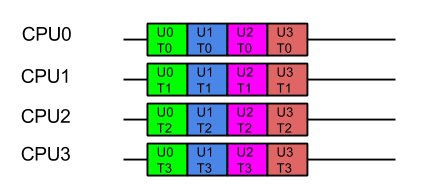
    Consider a server with 4 CPUs serving 4 users each which each have 4 tasks. The applications ideal view of parallel decomposition looks like:

    Label UxTy represent Task y for User x. Tasks for the same user are coloured alike

    This view suggests that each user’s combined task will be executed in minimum time. However some users must wait for prior users tasks to complete before their execution can start, so average latency is higher.

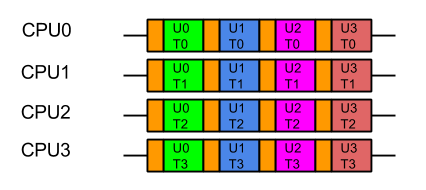
    Furthermore, we know from Mechanical Sympathy that such ideal execution is rarely possible, especially if there is data shared between tasks. Each CPU needs time to load its cache and register with data before it can be acted on. If that data is specific to the problem each user is trying to solve, then the real view of the parallel execution looks more like the following, the orange blocks indicating the time taken to load the CPU cache with user and task related data:

    Label UxTy represent Task y for User x. Tasks for the same user are coloured alike. Orange blocks represent cache load time.

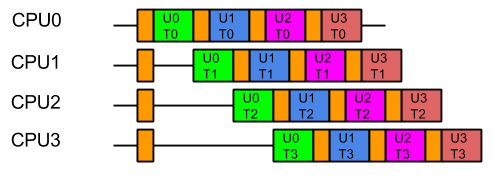
    So from the containers point of view, the last thing it wants is the data from one users large problem spread over all its CPUs, because that means that when it executes the next task, it will have a cold cache and it must be reloaded with the data of the next user.  Furthermore, executing tasks for the same user on different CPUs risks Parallel Slowdown, where the cost of mutual exclusion, synchronisation and communication between CPUs can increase the total time needed to execute the tasks to more than serial execution.  If the tasks are fully mutually excluded on user data (unlikely but a bounding case), then the execution could look like:

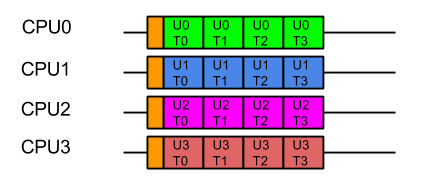
    For optimal execution from the containers point of view it is far better if tasks from each user, which use common data, are kept on the same CPU so the cache only needs to be loaded once and there is no mutual exclusion on user data:

    While this style of execution does not achieve the minimal latency and throughput of the idealised application view, in reality it is the fairest and most optimal execution, with all users receiving similar quality of service and the optimal average latency.

    In summary, when scheduling the execution of parallel tasks, it is best to keep tasks that share data on the same CPU so that they may benefit from a hot cache (the original blog contains some micro benchmark results that quantifies the benefit).

    Produce Consume (PC)

    In order to facilitate the decomposition of large problems into smaller ones, the Jetty container uses the Producer-Consumer pattern:

    • The NIO Selector produces IO events that need to be consumed by reading, parsing and handling the data.
    • A multiplexed HTTP/2 connection produces Frames that need to be consumed by calling the Servlet Container. Note that the producer of HTTP/2 frames is itself a consumer of IO events!

    The producer-consumer pattern adds another way that tasks can be related by data. Not only might they be for the same user, but consuming a task will share the data that results from producing the task. A simple implementation can achieve this by using only a single CPU to both produce and consume the tasks:

    while (true)
    {
      Runnable task = _producer.produce();
      if (task == null)
        break;
       task.run();
    }

    The resulting execution pattern has good mechanical sympathy characteristics:

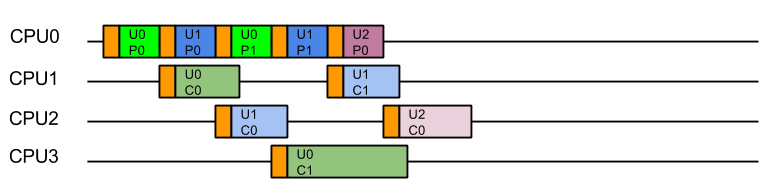
    Label UxPy represent Produce Task y for User x, Label UxCy represent Consume Task y for User x. Tasks for the same user are coloured in similar tones. Orange blocks are cache load times.

    Here all the produced tasks are immediately consumed on the same CPU with a hot cache!  Cache load times are minimised, but the cost is that server will suffer from Head of Line (HOL) Blocking, where the serial execution of task from a queue means that execution of tasks are forced to wait for the completion of unrelated tasks.  In this case tasks for U1C0 need not wait for U0C0 and U2C0 tasks need not wait for U1C1 or U0C1 etc. There is no parallel execution and thus this is not an optimal usage of the server resources.

    Produce Execute Consume (PEC)

    To solve the HOL blocking problem, multiple CPUs must be used so that produced tasks can be executed in parallel and even if one is slow or blocks, the other CPU can progress the other tasks.  To achieve this, a typical solution is to have one Thread executing on a CPU that will only produce tasks, which are then placed in a queue of tasks to be executed by Threads running on other CPUs.   Typically the task queue is abstracted into an Executor:

    while (true)
    {
        Runnable task = _producer.produce();
        if (task == null)
            break;
        _executor.execute(task);
    }

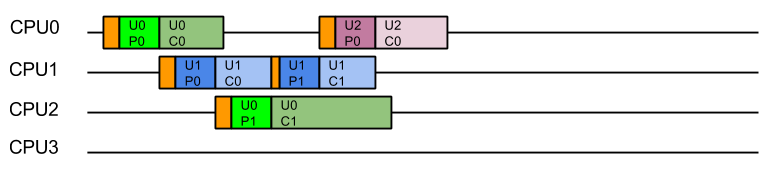
    This strategy could be considered the canonical solution to the producer consumer problem, where producers are separated from consumers by a queue and is at the heart of architectures such as SEDA. This strategy well solves the head of line blocking issue, since all tasks produced can complete independently in different Threads on different CPUs:

    This represents a good improvement in throughput and average latency over the simple Produce Consume, solution, but the cost is that every consumed task is executed on a different Thread (and thus likely a different CPU) from the one that produced the task.  While this may appear like a small cost for avoiding HOL blocking, our experience is that CPU cache misses significantly reduced the performance of early Jetty 9 releases.

    Eat What You Kill (EWYK) AKA Execute Produce Consume (EPC)

    To achieve good mechanical sympathy and avoid HOL blocking, Jetty has developed the Execute Produce Consume strategy, that we have nicknamed Eat What You Kill (EWYK) after the expression which states a hunter should only kill an animal they intend to eat. Applied to the producer consumer problem this policy says that a thread should only produce (kill) a task if it intends to consume (eat) it[n]The EatWhatYouKill strategy is named after a hunting proverb in the sense that one should only kill to eat. The use of this phrase is not an endorsement of hunting nor killing of wildlife for food or sport.[/n]. A task queue is still used to achieve parallel execution, but it is the producer that is dispatched rather than the produced task:

        while (true)
        {
            Runnable task = _producer.produce();
            if (task == null)
                break;
            _executor.execute(this); // dispatch production
            task.run(); // consume the task ourselves
        }

    The result is that a task is consumed by the same Thread, and thus likely the same CPU, that produced it, so that consumption is always done with a hot cache:

    Moreover, because any thread that completes consuming a task will immediately attempt to produce another task, there is the possibility of a single Thread/CPU executing multiple produce/consume cycles for the same user. The result is improved average latency and reduced total CPU time.

    Starvation!

    Unfortunately, a pure implementation of EWYK suffers from a fatal flaw! Since any thread producing a task will go on to consume that task,  it is possible for all threads/CPU to be consuming at once.   This was initially seen as a feature as it exerted good back pressure on the network as a busy server used all its resources consuming existing tasks rather than producing new tasks. However, in an application server consuming a task may be a blocking process that waits for more data/frames to be produced. Unfortunately if every thread/CPU ends up consuming such a blocking task, then there are no threads left available to produce the tasks to unblock them. Dead lock!

    A real example of this occurred with HTTP/2, when every Thread from the pool was blocked in a HTTP/2 request because it had used up its flow control window. The windows can be expanded by flow control frames from the other end, but there were no threads available to process the flow control frames!

    Thus the EWYK execution strategy used in Jetty is now adaptive and it can can use the most appropriate of the three strategies outlined above, ensuring there is always at least one thread/CPU producing so that starvation does not occur. To be adaptive, Jetty uses two mechanisms:

    • Tasks that are produced can be interrogated via the Invocable interface to determine if they are nonblocking, blocking or can be run in either mode.  NON_BLOCKING or EITHER tasks can be directly consumed by PC model.
    • The thread pools used by Jetty implement the TryExecutor interface which supports the method boolean tryExecute(Runnable task)which allows the scheduler to know if a thread was available to continue producing and thus allows EWYK/EPC mode, otherwise the task must be passed to an executor to be consumed in PEC mode.  To implement this semantic, Jetty maintains a dynamically sized pool of reserved threads that can respond to tryExecute(Runnable)calls.

    Thus the simple produce consume (PC) model is used for non-blocking tasks; for blocking tasks the EWYK, aka Execute Produce Consume (EPC) mode is used if a reserved thread is available, otherwise the SEDA style Produce Execute Consume (PEC) model is used.

    The adaptive EWYK strategy can be written as :

        while (true)
        {
            Runnable task = _producer.produce();
            if (task == null)
                break;
            if (Invocable.getInvocationType(task)==NON_BLOCKING)
                task.run();                     // Produce Consume
            else if (executor.tryExecute(this)) // recruit a new producer?
                task.run();                     // Execute Produce Consume (EWYK!)
            else
                executor.execute(task);         // Produce Execute Consume
        }
    

    Chained Execution Strategies

    As stated above, in the Jetty use-case it is common for the execution strategy used by the IO layer to call tasks that are themselves an execution strategy for producing and consuming HTTP/2 frames.  Thus EWYK strategies can be chained and by knowing some information about the mode in which the prior  strategy has executed them the strategies can be even more adaptive.

    The adaptable chainable EWYK strategy is outlined here:

      while (true) {
        Runnable task = _producer.produce();
        if (task == null)
          break;
        if (thisThreadIsNonBlocking())
        {
          switch(Invocable.getInvocationType(task))
          {
            case NON_BLOCKING:
              task.run();                 // Produce Consume
              break;
            case BLOCKING:
              executor.execute(task);     // Produce Execute Consume
              break;
            case EITHER:
              executeAsNonBlocking(task); // Produce Consume break;
           }
        }
        else
        {
          switch(Invocable.getInvocationType(task))
          {
            case NON_BLOCKING:
              task.run();                   // Produce Consume
              break;
            case BLOCKING:
              if (_executor.tryExecute(this))
                task.run();                 // Execute Produce Consume (EWYK!)
              else
                executor.execute(task);     // Produce Execute Consume
              break;
            case EITHER:
              if (_executor.tryExecute(this))
                task.run();                 // Execute Produce Consume (EWYK!)
              else
                executeAsNonBlocking(task); // Produce Consume
                break;
           }
        }

    An example of how the chaining works is that the HTTP/2 task declares itself as invocable EITHER in blocking on non blocking mode. If IO strategy is operating in PEC mode, then the HTTP/2 task is in its own thread and free to block, so it can itself use EWYK and potentially execute a blocking task that it produced.

    However, if the IO strategy has no reserved threads it cannot risk queuing an important Flow Control frame in a job queue. Instead it can execute the HTTP/2 as a non blocking task in the PC mode.  So even if the last available thread was running the IO strategy, it can use PC mode to execute HTTP/2 tasks in non blocking mode. The HTTP/2 strategy is then always able to handle flow control frames as they are non-blocking tasks run as PC and all other frames that may block are queued with PEC.

    Conclusion

    The EWYK execution strategy has been implemented in Jetty to improve performance through mechanical sympathy, whilst avoiding the issues of Head of Line blocking, Thread Starvation and Parallel Slowdown.   The team at Webtide continue to work with our clients and users to analyse and innovate better solutions to serve high performance real world applications.

  • CometD and NodeJS, part 2

    In our previous blog, we presented the case of a Webtide customer, Genesys, that needed to integrate CometD in NodeJS and how we developed a CometD client capable of running in the NodeJS environment.
    In this article we present the other side of the solution, that is, how we implemented the CometD NodeJS Server. Leveraging this, Genesys was able to use the standard CometD JavaScript Client in the browser front-end application to talk to the CometD NodeJS server application, which in turn used the CometD NodeJS Client to talk to the Java CometD server application.
    The CometD NodeJS Server is based on the same CometD concepts present in the CometD Java server.
    In particular, there is a central object, the CometDServer, that handles HTTP requests and responses provided by the NodeJS environment. The CometDServer object is also a repository for sessions and channels, that are the two primary concepts used in a server-side CometD application. Both sessions and channels emit events that an application can listen to in order to implement the required business logic.
    Installing the CometD NodeJS Server is easy:

    npm install cometd-nodejs-server
    

    The minimal setup of a CometD NodeJS Server application is the following:

    var http = require('http');
    var cometd = require('cometd-nodejs-server');
    var cometdServer = cometd.createCometDServer();
    var httpServer = http.createServer(cometdServer.handle);
    httpServer.listen(0, 'localhost', function() {
        // Business logic here.
    });
    

    Now you can use the CometD NodeJS Server APIs to be notified when a message arrives on a certain channel:

    var channel = cometdServer.createServerChannel('/service/chat');
    channel.addListener('message', function(session, channel, message, callback) {
        // Your message handling here.
        // Invoke the callback to signal that handling is complete.
        callback();
    });
    

    Further examples of API usages can be found at the CometD NodeJS Server project.
    With the CometD NodeJS Client and Server projects, Genesys was able to leverage CometD throughout the whole process chain, from the browser to NodeJS to the Java CometD server. This allowed Genesys the use of a consistent API throughout the whole architecture, with the same concepts and a very smooth learning curve for developers.

  • CometD and NodeJS, part 1

    In addition to our Lifecycle Support offerings, Webtide is also committed to helping develop new functionality to meet customer needs for the open source projects Webtide supports, CometD and Eclipse Jetty.
    Recently Genesys, a global leader in customer experience solutions and one of Webtide’s customers, reached out regarding their usage of CometD, looking for help integrating CometD with NodeJS.
    Their architecture had a browser front-end application talking to a NodeJS server application, which in turn talked to a Java CometD server application. Server-side events emitted by the CometD application needed to travel through NodeJS all the way down to the front-end, and the front-end needed a way to register interest for those events.
    At the time the CometD project did not have any NodeJS integration, so Genesys partnered with Webtide to develop the integration as a sponsored effort, leveraging our knowledge as the experts behind CometD.
    This resulted in two new CometD sub-projects, CometD NodeJS Client and CometD NodeJS Server, and in publishing CometD artifacts in NPM.
    The first step was to publish the CometD JavaScript Client to NPM. Starting with CometD 3.1.0, you can now do:

    npm install cometd

    and have the CometD JavaScript Client available for developing your front-end applications.
    However, the CometD JavaScript Client does not run in NodeJS because it assumes a browser environment. In particular it assumes the existence of the window global object, and of the XMLHttpRequest APIs and functionalities such as HTTP cookie handling.
    Initially, rewriting a pure NodeJS CometD client was considered, but discarded as it would have duplicated a lot of code written with years of field experience. It turned out that implementing the parts of the browser environment needed by the CometD JavaScript Client was simpler, and the CometD NodeJS Client was born.
    The CometD NodeJS Client implements the minimum requirements to run the CometD JavaScript Client inside a NodeJS environment. It uses the NodeJS HTTP facilities to implement XMLHttpRequest, exposes a window global object and few other functionalities present in a browser environment such as timers (window.setTimeout(...)) and logging (window.console).
    Writing a CometD NodeJS client application is now very simple. First, install the CometD client libraries:

    npm install cometd-nodejs-client
    npm install cometd
    

    Second, write your application:

    require('cometd-nodejs-client').adapt();
    var lib = require('cometd');
    var cometd = new lib.CometD();
    ...
    

    Following this framework, Genesys was able to utilize CometD from within NodeJS to talk to the Java CometD server application and vice-versa.
    In the next blog we will take a look at the CometD NodeJS Server which allows the front-end application to talk to the NodeJS server application, therefore using CometD from the front-end application through NodeJS to the Java CometD server.

  • Jetty-9.3 Features!

    Jetty 9.3.0 is almost ready and Release Candidate 1 is available for download and testing!  So this is just a quick blog to introduce you to what is new and encourage you to try it out!

    HTTP2

    The headline feature in Jetty-9.3 is HTTP/2 support. This protocol is now a proposed standard from the IETF and described in RFC7540. The Jetty team has been closely involved with the development of this standard, and while we have some concerns about the result, we believe that there are significant quality of service gains to be had by deploying HTTP/2.   The protocol has features that can greatly reduce the time to render a web page, which is good for clients; plus it has some good economies in using a fewer connections, which is good for servers.

    Jetty has comprehensive support for HTTP/2: Client, Server with negotiated, upgraded and direct connections and the protocol is already supported by the majority of current browsers. Since HTTP2 is substantially based on the SPDY protocol, we have dropped SPDY support from Jetty-9.3.

    Deploying HTTP/2 in the server is just the same as configuring a https connector : java -jar $JETTY_HOME/start.jar --add-to-startd=http2 will get you going (more blogs and doco coming)!

    Webtide is actively seeking users interested in deploying HTTP2 and collaborating on analysis of load, latency, configuration and optimisations.

    ALPN

    To support standard based negotiation of protocols over new connections (eg. to select HTTP2 or HTTPS),  Jetty-9.3 supports the Application Layer Protocol Negotiation mechanism which replaces our previous support for NPN.

    ALPN will automatically be enabled when HTTP2 is enable with start.jar, which downloads a non-eclipse jar containing our own extension to Open JVM and is not covered by the eclipse licenses.

    SNI

    Jetty-9.3 also supports Server Name Indications during TLS/SSL negotiation.  This allows the key store to contain multiple server certificates that have a specific or wild card domain(s) encoded in their distinguished name or by the Subject Alternate Name X.509 extension.     This allows a server with many virtual hosts/contexts to pick the appropriate TLS/SSL certificate for a connection.

    Enabling SNI support is a simple as adding the multiple certificates to your keystore file!

    Java 8

    Jetty-9.3 is built and targeted for Java 8.  This change was prompted by the SNI extension reliance on a Java 8 API and the HTTP2 specification need for TLS ciphers that are only available in Java 8.  It is possible to build Jetty-9.3 for Java 7 and we were considering releasing it as such with a few configuration tricks to enable the few classes that require java 8, however we decided that since java 7 is end-of-life is was not worth the complication to support it directly in the release.   If you really need java 7, then please speak to Webtide about a build of 9.3 for 7.

    Eat What You Kill

    It is impossible to change the protocol as server speaks without dramatic changes on how it is optimized to scale to high loads and low through puts.  The support of HTTP2 requires some fundamental changes to the core scheduling strategies, specifically with regards to the challenge of handling multiplexed requests from a single connection.   Jetty 9.3 contains a new scheduling strategy nicked named Eat What You Kill that makes 9.3 faster out of the box and gives us the opportunity to continue to improve throughput and latency as we tune the algorithm.

    Reactive Asynchronous IO Flows?

    Jetty 9.2 already supports the Servlet Asynchronous IO API and Asynchronous Servlets.  However, in Jetty 9.3 that support has been made even more fundamental and all IO in Jetty is now fundamentally asynchronous from the connector to the servlet streams and robust under arbitrary access from non container managed threads.

    So Jetty-9.3 is a good basis on which to develop with the servlet asynchronous APIs, however as we have some concerns with the complexity of those APIs, we are actively experimenting with better APIs based on Reactive Programming and specifically on the Flow abstraction developed by Doug Lea as a candidate class for Java 9.   We have a working prototype that runs on Jetty-9.3 which we hope to release soon.  Please contact us if you are interested in  participating in this development, as real use-cases are required to test these abstractions!